A landscaping contractor who books a restroom trailer for six months every year called us with a question he’d clearly been chewing on for a while: “At what point am I just paying for a trailer I don’t even own?” He’d done the rough math in his head a dozen times and kept landing on a different answer, mostly because he was comparing a monthly rental rate against a purchase price without accounting for everything ownership actually costs beyond the sticker price.
That’s the trap most contractors fall into when they think about renting vs. buying a restroom trailer. It looks like a simple comparison — rental cost per season versus purchase price — but ownership carries costs that never show up on a rental invoice: maintenance, storage, insurance, depreciation, and the labor of managing the unit yourself. A real break-even analysis has to account for all of it, not just the two headline numbers.
Key Takeaways
- The break-even point isn’t rental cost versus purchase price alone — it’s total annual rental cost versus total annual cost of ownership, including maintenance, storage, and insurance.
- Contractors who rent seasonally, not year-round, often reach break-even much later than they expect, because ownership costs continue even when the trailer isn’t earning its keep.
- Depreciation and resale value matter as much as the purchase price — a trailer that holds value well changes the math significantly.
- Rental flexibility has real value that’s easy to underweight in a pure cost comparison, especially for contractors whose crew size or project volume fluctuates year to year.
- Running your own numbers with your actual usage pattern beats any generic rule of thumb about “rent under X months, buy over Y.”
Why the Simple Comparison Gets This Wrong
The instinct most contractors have is to compare rental cost per season against purchase price and see how many seasons it takes to “pay off” the trailer. That comparison feels intuitive, but it leaves out most of what ownership actually costs. A purchased trailer doesn’t stop costing money once it’s paid for — it needs routine maintenance, a place to store it in the off-season, insurance coverage, and eventually repairs that a rental company would have absorbed as part of your rental fee.
Rental cost, on the other hand, is close to the total cost — delivery, setup, maintenance, and often pump-out service are typically bundled in, meaning the number on your rental invoice is close to the full picture. Comparing a rental company’s all-in number against just a trailer’s purchase price isn’t a fair comparison until you build out ownership’s full cost picture the same way.
Building the Real Break-Even Formula
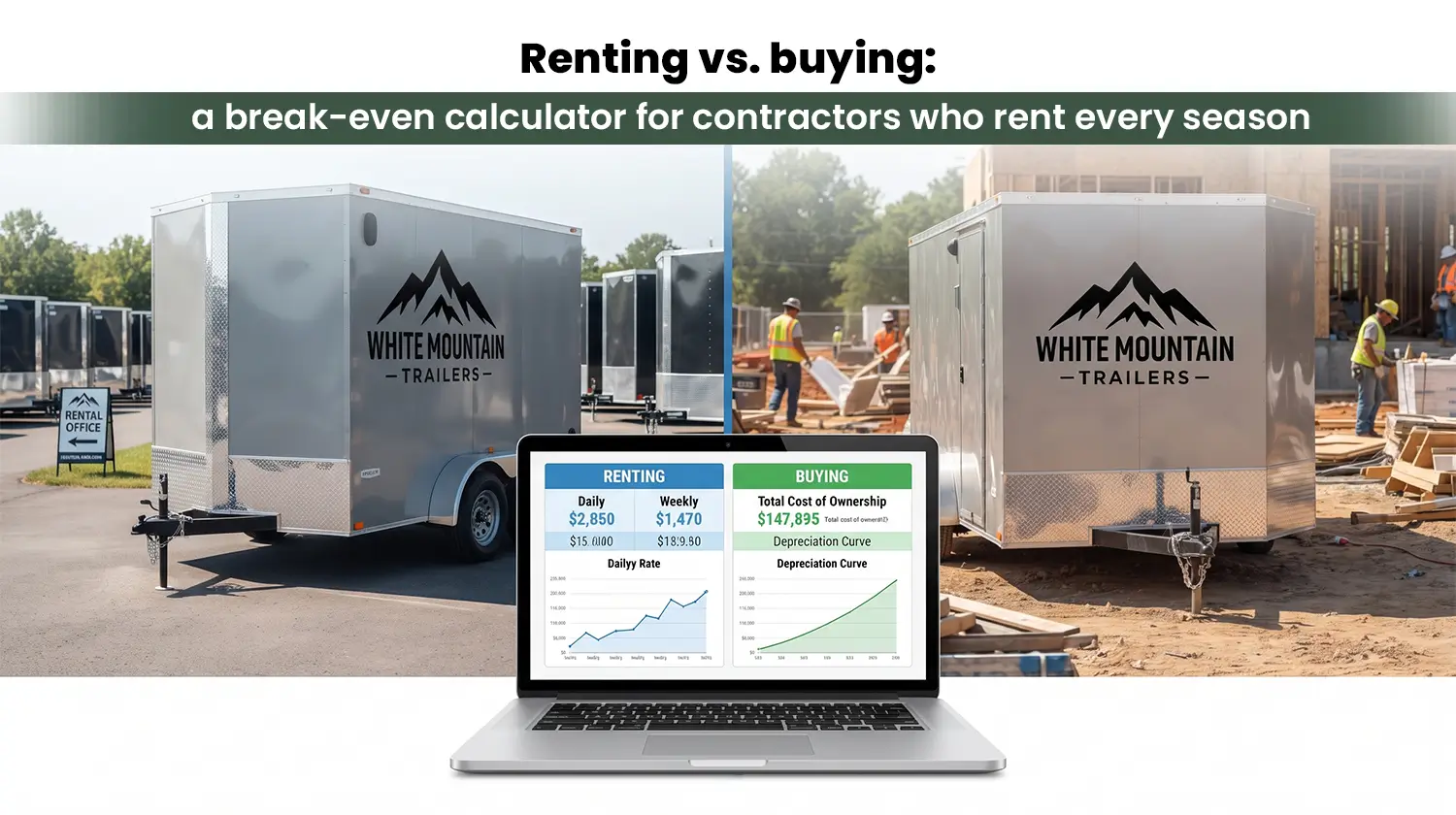
A workable break-even calculation looks like this:
Total annual cost of renting = (rental rate × number of rental periods per year)
Total annual cost of owning = (purchase price ÷ expected years of use) + annual maintenance + storage costs + insurance − any resale value recovered at end of use, divided across ownership years
The break-even point is the number of years it takes for cumulative ownership cost to drop below cumulative rental cost, given your actual seasonal usage pattern — not a generic industry estimate.
Here’s a simplified example to show how the mechanics work. If a seasonal rental runs $3,000 for a six-month season, that’s $3,000 a year in rental cost. A comparable trailer purchase at $45,000, with an expected 10-year useful life, $1,200 a year in maintenance, $600 a year in storage, and $500 a year in insurance, works out to roughly $6,800 a year in ownership cost before any resale value is factored in. In this illustration, renting stays cheaper every year unless usage increases significantly or the trailer holds strong resale value at the end of its service life. Your actual numbers will look different — this is a framework to plug your own figures into, not a universal answer.
Factor #1: How Many Seasons You Actually Rent Per Year
This is the single biggest variable in the whole calculation. A contractor renting a trailer for two months every summer has a completely different break-even timeline than one renting nine months out of twelve. Ownership costs accrue whether the trailer is working or sitting in storage, so the more months a year the trailer would sit idle if you owned it, the longer it takes ownership to catch up to renting.
If your rental pattern is genuinely seasonal — busy months followed by a long off-season — that idle-time cost is often the deciding factor against buying, even when the raw purchase-price-versus-rental-cost math looks close.
Factor #2: Maintenance and Repair Costs You’d Absorb
Rental companies build maintenance into their pricing because it’s their job to keep the unit functional — you never see a separate invoice for a fixed pump, a replaced water heater, or worn flooring. Owning the same trailer means those costs land on you directly, and they don’t arrive on a predictable schedule. Budgeting a flat annual maintenance estimate is reasonable for planning purposes, but real repair costs tend to spike unpredictably, especially as a unit ages past its first few years.
Factor #3: Storage and Off-Season Costs
A trailer you own needs somewhere to sit during the months you’re not using it, and that space isn’t free even if it feels like it because you already have a yard or lot. Factor in winterization if you’re in a climate with hard freezes, plus the labor of prepping and de-prepping the unit each season. None of this shows up when you rent, because the rental company handles storage and readiness between seasons as part of their business.
Factor #4: Depreciation and Resale Value
A trailer’s value doesn’t stay flat — it depreciates from the day it’s purchased, and how much value it retains at resale meaningfully changes your effective ownership cost. A well-built, well-maintained trailer that holds value well shifts the break-even point earlier; a unit that depreciates quickly or has a thin resale market pushes it later. This is where trailer quality and brand reputation genuinely affect the financial math, not just the day-to-day experience of using it.
Factor #5: The Value of Flexibility
Renting gives you the ability to scale up or down based on project volume, upgrade to a different unit size as your business grows, and walk away entirely if your business shifts direction — none of which a purchased asset allows. This flexibility has real financial value even though it doesn’t show up as a line item. A contractor whose crew size fluctuates year to year, or who isn’t certain restroom trailer rentals will remain part of the business in five years, should weight this factor heavily, even if a pure numbers comparison looks close to even.
Questions to Ask Yourself Before Running the Numbers
- How many months per year do I actually need a restroom trailer, realistically, not optimistically?
- Do I have a place to store it, and what would winterizing and off-season upkeep actually cost?
- How confident am I that my usage pattern will stay consistent for the next 5-10 years?
- What’s the realistic resale value of the specific trailer I’m considering buying?
- Does my business benefit more from flexibility (renting) or from a fixed, depreciating asset (owning)?
Frequently Asked Questions
At what point does buying a restroom trailer make more sense than renting?
It depends entirely on your usage pattern. Contractors who need a trailer close to year-round, with a reliable storage plan and confidence in consistent demand for years to come, are more likely to reach a favorable break-even point than those with a short seasonal window.
Does rental cost really include everything, or are there hidden fees?
Most rental agreements bundle delivery, setup, and routine maintenance into the price, but pump-out and servicing terms vary by company. Confirm exactly what’s included before comparing a rental quote against ownership costs, so you’re comparing complete numbers on both sides.
How much does owning a restroom trailer cost beyond the purchase price?
Ongoing ownership costs typically include annual maintenance, storage, insurance, and eventual repairs — plus the opportunity cost of capital tied up in the asset. These costs continue whether or not the trailer is actively being used.
Does trailer quality actually affect the rent-vs-buy decision?
Yes. A well-built trailer with strong resale value and lower repair frequency shifts the break-even point earlier than a lower-quality unit that depreciates quickly and needs frequent repairs.
Is there a simple rule of thumb for how many rental seasons before buying pays off?
Not a reliable one — usage pattern, maintenance costs, storage situation, and resale value all vary too much between contractors for a generic rule to hold up. Running your own numbers against your actual seasonal pattern gives a far more accurate answer.
Not Sure Which Option Fits Your Business?
Renting versus buying a restroom trailer isn’t a decision with one right answer — it depends on how many months a year you actually need it, what storage and maintenance would cost you, and how much your business benefits from flexibility over ownership.
White Mountain Trailers has worked with contractors across Northern Arizona, from Flagstaff to Pinetop-Lakeside, for two generations, and we’re happy to walk through your seasonal usage pattern and help you figure out which option actually makes financial sense for your business.
Call 928-358-8404 or visit wmtrailers.com to talk through your rental or purchase options.