A pipeline crew supervisor once called us the morning of a scheduled delivery, confused about why our driver had turned around a half-mile from the site. The access road looked fine to him — he drove it in a pickup every day. What he hadn’t accounted for was a loaded restroom trailer weighing several thousand pounds, a truck-and-trailer combination needing real turning room, and a final stretch of road soft enough to swallow a tire the moment it left the packed center line.
That gap between “a truck can get there” and “a delivery truck towing a loaded trailer can get there and turn around” is where most remote job site logistics problems start. Delivery and setup for a restroom trailer isn’t just about picking a date — it’s about making sure the physical site can actually receive the unit once it arrives. Get the access, grading, and leveling right before delivery day, and setup is routine. Get it wrong, and you’re looking at a delayed job, a rescheduled crew, or a trailer parked somewhere less convenient than where you actually wanted it.
Key Takeaways
- Access roads need enough width, turning room, and overhead clearance for a truck towing a fully loaded trailer — not just enough room for a pickup.
- Ground condition matters as much as ground shape: firm, stable surfaces are required because a loaded trailer can sink into soft or muddy ground.
- Restroom trailers must sit level to function correctly — minor grades can be corrected with leveling equipment, but steep slopes generally can’t.
- Utility proximity (power and water) affects setup complexity even on sites using self-contained systems, since distance drives cord and hose length needs.
- A site survey or even just photos of the access route, shared with your rental company ahead of time, catches most delivery problems before the truck ever leaves the yard.
Why Remote Job Sites Need a Different Delivery Plan Than Standard Sites
Delivering a restroom trailer to a paved lot with a wide driveway is straightforward. Delivering to a remote job site — a pipeline right-of-way, a rural construction lot, a backcountry event venue — is a different logistics problem entirely, because the roads, ground conditions, and turnaround space that work fine for daily crew traffic often aren’t built for a loaded delivery truck and trailer combination.
Site accessibility is one of the most common challenges rental companies face, particularly at construction sites, festivals, and remote locations without well-paved roads or easy access points — narrow paths, steep inclines, and muddy terrain can all turn a routine delivery into a logistical problem. The fix isn’t complicated, but it does require doing the legwork before delivery day instead of discovering the problem when the truck is already en route.
Access Road Requirements: Width, Clearance, and Turning Room
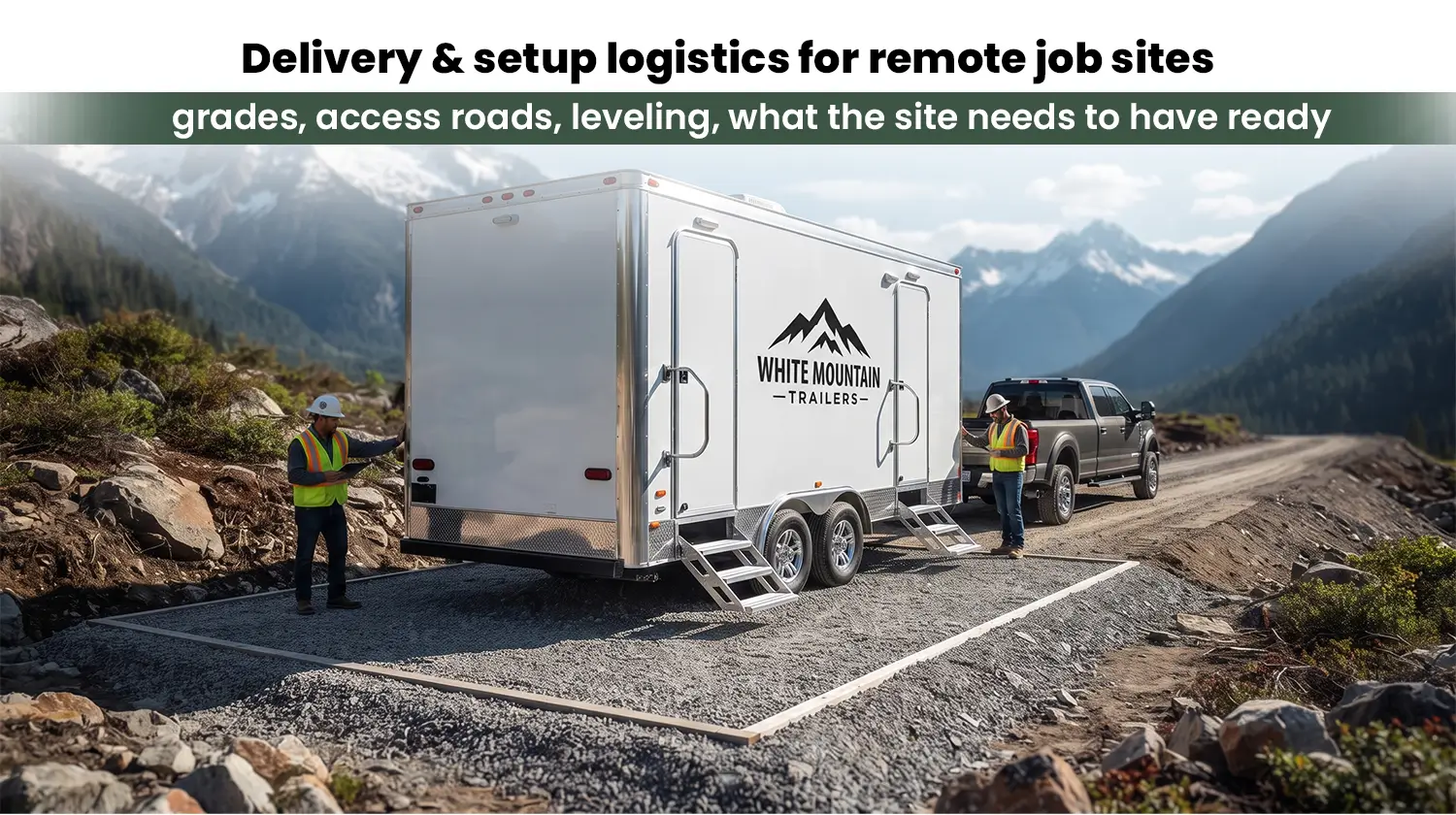
The road leading to your site needs to accommodate more than a pickup truck. A driveway or access road generally needs to be at least 10 feet wide to accommodate the delivery truck and trailer together, with overhead clearance of at least 12 feet — sometimes 14 feet depending on the unit — to clear low-hanging branches, power lines, or archways along the route.
Turning radius is the piece most people underestimate. A standard tow setup needs roughly 60 feet of turning radius to maneuver into position, which means a road that’s wide enough to drive down isn’t automatically wide enough to turn around on, especially at the delivery point itself. If your site has a single narrow access point with no room to turn around, flag that to your rental company before delivery day — there may be a workaround, but it needs to be planned, not discovered on-site.
Gates and locked access points are worth confirming too. If there are gates or barriers along the route, confirm they open wide enough for the delivery vehicle and that someone will be available with keys or codes when the truck arrives — a locked gate with nobody available to open it is one of the most avoidable delivery delays there is.
Ground Condition: Why Firm and Stable Matters More Than It Sounds
A loaded restroom trailer is heavier than most people expect, often weighing several thousand pounds once its tanks are filled, which means the ground underneath it needs to actually hold that weight without shifting. If the ground is too soft, the trailer can sink or become unstable, and in some cases the delivery crew may need to use stabilizing pads or recommend a different placement location entirely.
Surface type matters here. Asphalt or concrete is the ideal placement surface because it’s level, stable, and easy to access, with compacted gravel as a strong alternative that also provides drainage. Level grass or packed dirt can work for most jobs, but soft, sandy, or recently rain-soaked ground is a real risk — heavy rain before delivery can turn a workable grass site into mud that won’t support the trailer’s weight.
For remote job sites specifically, this is worth checking proactively rather than assuming. A spot that’s been fine for foot and light vehicle traffic all season may not hold up under a stationary, fully-loaded trailer sitting in one place for weeks.
Leveling and Grade: Why Flat Ground Isn’t Optional
Restroom trailers need to sit level for the plumbing systems to function correctly — tanks drain properly, fixtures work as designed, and the unit doesn’t develop the kind of imbalance that leads to leaks or drainage problems over time. Minor grades, generally in the range of a couple of degrees, can usually be corrected with leveling blocks or jacks, but a genuinely steep slope isn’t something leveling equipment can fix — it typically means finding a different spot on the site entirely.
This is one of the easiest things to check ahead of time. Before delivery day, walk the intended placement spot yourself and look for any noticeable slope, then flag it to your rental company rather than letting the delivery crew discover it on arrival. If the site is large enough to have more than one viable placement option, having a backup spot identified in advance saves real time if the first choice turns out to be less level than it looked.
Utility Proximity: Power, Water, and Why Distance Still Matters
Many restroom trailers today run on self-contained systems — onboard freshwater tanks, sealed waste tanks, and generator power — which makes them workable on job sites with no permanent utility hookups at all. But proximity to an actual power or water source still matters if your unit uses hookups rather than fully self-contained systems: placing the trailer within roughly 100 feet of an electrical outlet or water source keeps cord and hose runs manageable, rather than stringing long extension cords and hoses across an active job site.
For remote sites relying entirely on generator power and onboard tanks, this is less of a concern, but it’s worth confirming directly with your rental company which setup your specific unit uses, since that changes what your site actually needs to have ready.
What to Send Your Rental Company Before Delivery Day
The fastest way to avoid a delivery-day surprise is giving your rental company a clear picture of the site in advance. Photos of the access path shared ahead of time let an experienced provider quickly assess whether delivery is possible as planned, or whether an alternative route, placement, or equipment approach is needed. For genuinely remote or complex sites, a short site survey or phone walkthrough with the rental company beats guessing.
Site-Readiness Checklist for Remote Job Sites
- Access road at least 10 feet wide with at least 12 feet of overhead clearance along the full route
- Enough turning room (roughly 60 feet of radius) at the delivery and placement point
- Gates unlocked or someone available on-site to open them at delivery time
- Firm, stable ground at the placement spot — confirmed dry, not just visually level
- Placement spot checked for slope, with a backup location identified if the primary spot isn’t level enough
- Distance from placement spot to nearest power/water source measured, if the unit isn’t fully self-contained
- Photos of the access route shared with your rental company in advance for remote or unfamiliar sites
Questions to Ask Before Delivery Day
- Based on my site photos, does our access road and turning space work for your delivery vehicle?
- Is our ground firm enough, or should we plan for stabilizing pads or an alternate placement?
- What’s your leveling process if the spot has a minor grade?
- Does this unit need utility hookups, or is it fully self-contained for a remote site like ours?
- What happens if your crew arrives and the site isn’t ready — is there a rescheduling fee?
Frequently Asked Questions
How wide does our access road need to be for restroom trailer delivery?
Generally at least 10 feet wide to accommodate the delivery truck and trailer together, with at least 12 feet of overhead clearance along the route. Narrower roads or lower clearances should be flagged to your rental company before delivery day.
Can a restroom trailer be delivered on an unpaved or gravel road?
Yes, in most cases. Compacted gravel is considered a strong alternative to pavement, since it offers good drainage and stability. Soft, sandy, or muddy unpaved roads are the bigger concern, especially after rain.
What happens if our site isn't level?
Minor grades can usually be corrected with leveling blocks or jacks. Steep slopes generally can’t be leveled on-site and may require choosing a different placement spot on the property.
Does a remote job site need power and water hookups for a restroom trailer?
Not necessarily. Many units run on self-contained systems with onboard water tanks and generator power, which makes them workable on sites with no permanent utilities at all. Confirm with your rental company which setup your specific unit uses.
What's the best way to prepare for delivery to a hard-to-reach site?
Send your rental company photos of the access route ahead of time, and flag anything unusual — narrow roads, gates, soft ground, or slopes — before delivery day rather than during it. For genuinely remote sites, a phone walkthrough or site survey ahead of time is worth the extra step.
Planning a Delivery to a Remote Job Site?
Getting a restroom trailer to a hard-to-reach site isn’t complicated once the access, ground, and leveling details are sorted out ahead of time — the problems only show up when nobody checks in advance.
White Mountain Trailers has delivered and set up restroom, shower, and sink trailers across remote job sites throughout Northern Arizona, from Flagstaff to Pinetop-Lakeside, for two generations. Send us photos of your access route and we’ll tell you exactly what to have ready before our truck shows up.
Call 928-358-8404 or visit wmtrailers.com to plan your remote job site delivery.