A crew foreman outside Pinetop called us last summer with a simple problem: twelve guys, one job site, and a shower trailer built for four. Every morning turned into a scheduling headache before anyone even picked up a tool. By the time the last worker showered, half the crew was already standing around waiting on him.
It wasn’t a bad trailer. It was the wrong size.
That’s the question we get more than almost any other at White Mountain Trailers: how many stations do you actually need? The honest answer is it depends on your crew size, your schedule, and how much downtime you’re willing to tolerate. Here’s how to think it through.
Why Station Count Is the Decision That Matters Most
A shower trailer is only as useful as its throughput. Get the station count wrong in either direction, and you’re paying for it — either in wasted crew time every single morning, or in wasted rental and fuel costs on space you didn’t need.
Too few stations bottleneck your crew. If ten people are cycling through two stalls before a 7 a.m. start, you’re losing productive hours to a line, not to the job.
Too many stations waste your budget. An 8-station unit sitting mostly empty still needs the same water hookup, waste management, and generator draw as one running at full capacity.
The right size isn’t about getting the biggest trailer available. It’s about matching the unit to how your site actually operates.
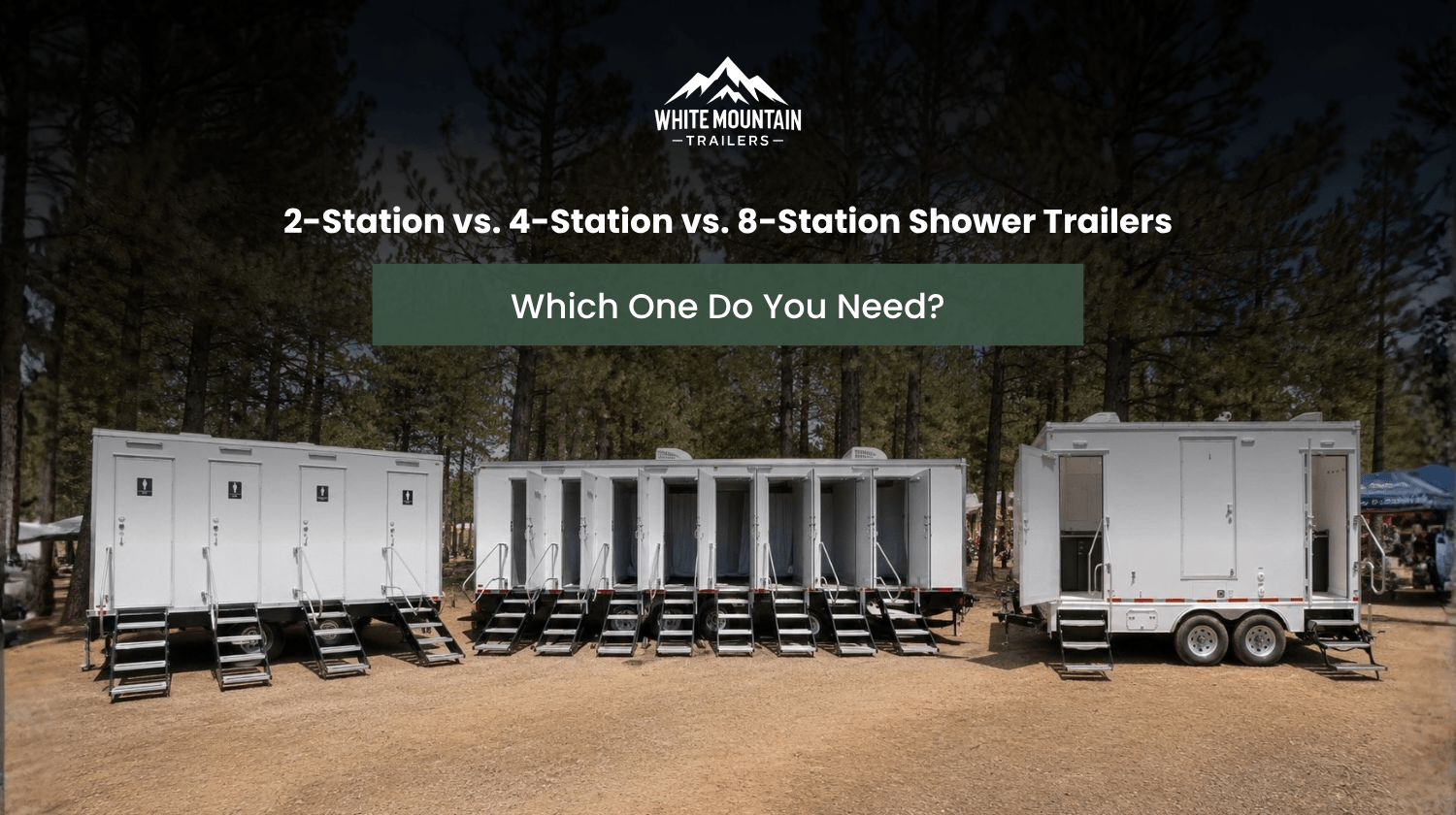
2-Station Trailers: Built for Small, Tight-Knit Crews
A 2-station trailer works well when you’ve got a small crew — usually under 8 people — or when showers are a convenience rather than a daily necessity for the whole team.
This size makes sense for:
- Small residential or light commercial jobs
- Crews working staggered shifts, so not everyone needs the trailer at once
- Short-term projects where a compact footprint matters for site space
- Budget-conscious rentals where minimizing water and generator use is a priority
If your crew is small enough that everyone already coordinates informally — who grabs coffee first, who leaves early — a 2-station trailer usually keeps pace just fine.
4-Station Trailers: The Middle Ground for Mid-Sized Crews
This is the size most contractors land on, and for good reason. A 4-station trailer handles a crew in the 10–20 person range without turning the morning routine into a bottleneck, and without paying for capacity you’re not using.
This size makes sense for:
- General commercial construction with a steady, mid-sized crew
- Sites running a single shift with a defined start time everyone hits at once
- Projects long enough to justify the added setup, but not sprawling enough to need more
- Contractors who want some buffer for a slightly larger crew down the line
If you’re not sure whether you need a 2-station or a 4-station, we usually recommend sizing up. A little extra capacity costs less than a crew standing around waiting on hot water.
8-Station Trailers: For Large Crews and Big Sites
Once you’re running 25 or more people through a single site, an 8-station trailer stops being a luxury and starts being the only thing that keeps a morning schedule realistic.
This size makes sense for:
- Large-scale commercial, highway, or infrastructure projects
- Multi-crew sites where several teams rotate through on tight shift changes
- Remote or extended-stay projects where workers are living on or near the site
- Disaster recovery and utility restoration work, where crew size can scale up fast
Large crews also tend to have less flexibility in their schedules — everyone starts and ends at the same time, which means everyone hits the shower trailer at the same time too. An 8-station unit is built for exactly that kind of concentrated demand.
A Quick Way to Think It Through
Before deciding, run through these questions:
- How many people are on-site at peak? Size for your busiest day, not your average one.
- Is everyone on the same schedule? Staggered shifts need fewer stations than a single shared start time.
- How long is the project? Short jobs can tolerate a tighter squeeze; long ones can’t.
- Is this a rental or a long-term investment? Renting gives you room to resize as the project changes; buying means planning for your typical crew size, not just this one job.
If two answers point you toward different sizes, size up. The cost difference is minor. The cost of a stalled morning routine, multiplied over months, isn’t.
Get the Right Size the First Time
Sizing a shower trailer isn’t guesswork — it’s a handful of straightforward questions about your crew and your site. Get it right, and the trailer disappears into the background of a smooth-running job. Get it wrong, and it becomes the thing everyone complains about at 6:45 a.m.
White Mountain Trailers has been building and renting shower trailers for Northern Arizona contractors — from Flagstaff to Pinetop-Lakeside — for two generations. Tell us your crew size and site setup, and we’ll help you land on the right fit the first time.
Call 928-532-2434 or visit wmtrailers.com to talk through what your crew needs.