A festival organizer in Show Low once described their old restroom setup in one word: “triage.” Three trailers, none of them big enough, staff running between units all weekend just to keep lines from backing into the food vendor row. The next year they booked a single 10-stall trailer instead. Same guest count, same three-day run — but for the first time, nobody on staff had to think about restrooms at all.
That’s the real argument for going big: at a certain point, more units isn’t the same as more capacity. One properly sized trailer beats three scattered ones, every time.
Why 8 and 10 Stalls Exist as Their Own Category
Once an event crosses into the 200-to-500+ guest range, the math changes. It’s not just about total capacity anymore — it’s about how many people need to go at the same moment, and how long that moment lasts.
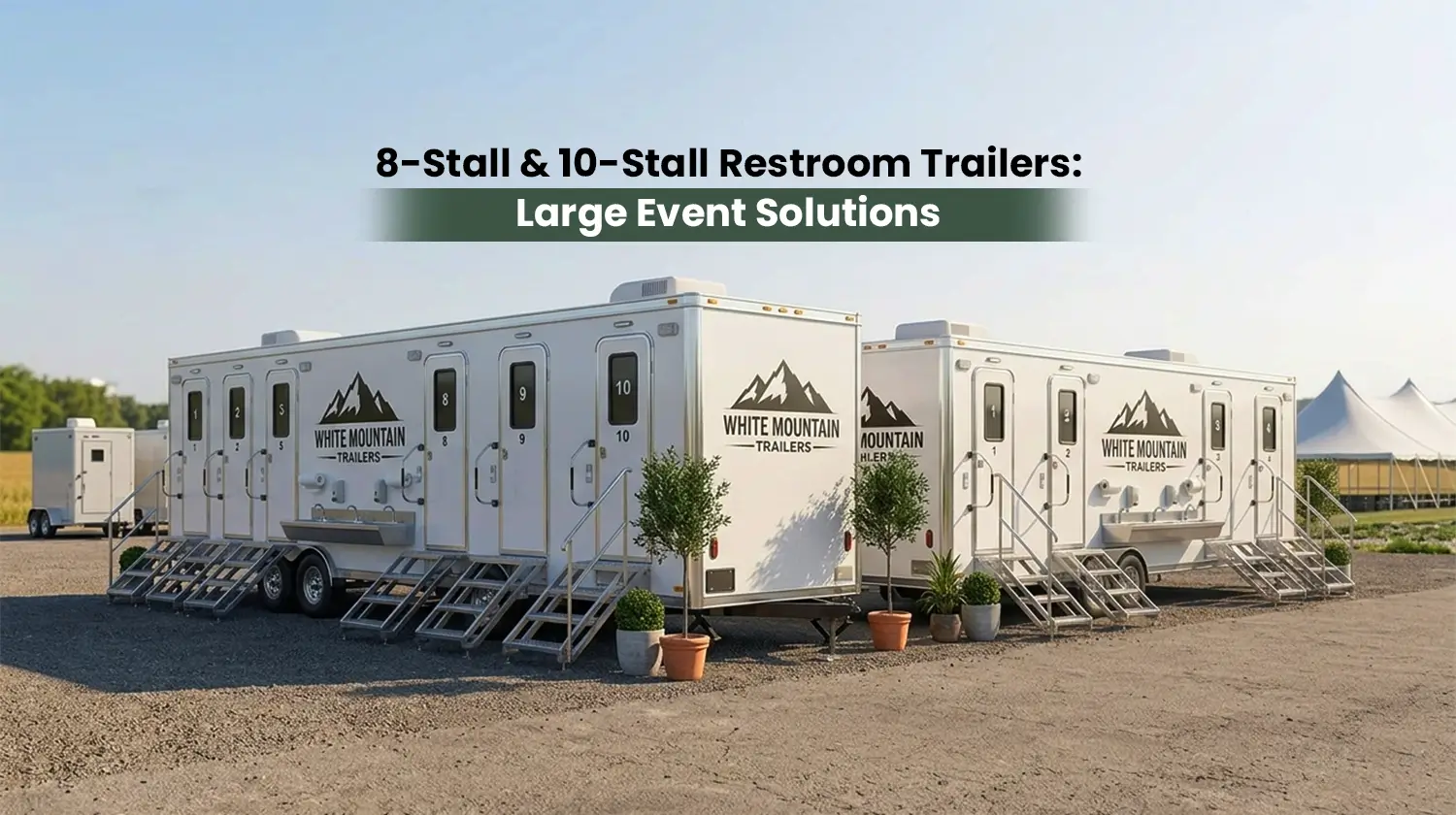
An 8-stall trailer typically splits four stalls to a side, giving eight people access at once. A 10-stall steps that up further, often with a wider dual-entry layout so lines never funnel into a single doorway. Both sizes usually come standard with:
- Separate men’s and women’s sections, sometimes with dedicated ADA-accessible stalls.
- Real plumbing — flushing toilets and running-water sinks, not chemical units.
- Climate control, so an all-day event in July or January doesn’t become its own problem.
- Attendant-ready space, since large events often staff someone to keep the trailer stocked and clean throughout the day.
These aren’t scaled-up versions of a backyard wedding trailer. They’re built for continuous, high-volume use over long hours — which is a different engineering problem than an occasional rush during cocktail hour.
Best Uses for 8-Stall and 10-Stall Trailers
This size class fits events where the guest count is large, and the event runs long enough that a single wave of usage would overwhelm anything smaller.
Where it fits well:
- Weddings and galas with 250+ guests, especially multi-hour receptions with an open bar
- Multi-day music festivals, fairs, and rodeos with steady all-day foot traffic
- Large corporate events — conferences, company picnics, product launches — with several hundred attendees
- Construction sites or remote job sites running large crews (50+) over extended timelines
- Municipal and public events — parades, marathons, community festivals — where the general public, not just guests, will be using the units
The common thread: these events don’t have a single predictable rush. They have restroom demand running steadily for six, eight, twelve hours at a stretch, sometimes across multiple days without a break to reset.
When You Need More Than One Unit
Even a 10-stall trailer has a ceiling. A few signs it’s time to talk about multiple units instead of one larger trailer:
- Guest counts well past 500, especially spread across a large festival footprint
- Multiple stages, entrances, or activity zones far enough apart that guests won’t walk back to a single central trailer
- Multi-day events where one unit needs servicing while guests still need access
- A layout where the venue itself is spread across acres, not a single lot
In those cases, the better solution is often two mid-size trailers positioned at opposite ends of the site rather than one massive unit in the middle. Distance matters as much as raw stall count — a guest won’t walk ten minutes across a festival grounds no matter how short the line is when they get there.
8-Stall & 10-Stall vs. Other Sizes at a Glance
Here’s how this size class compares to what’s typically used below it.
- 4-stall: Best for 100 to 200 guests, mixed seated and standing time, open bars.
- 8-stall: Best for 200 to 400 guests, all-day events, larger weddings and corporate gatherings.
- 10-stall: Best for 400 to 500+ guests, festivals, multi-day events, or continuous public foot traffic.
- Multiple units: Best for 500+ guests spread across a large or multi-zone venue.
Most events that reach out asking about 8- or 10-stall trailers already know a smaller unit won’t cut it — the guest list or the event length has already made that clear. The real question at this size is usually placement and power/water hookups, not whether the size itself is right.
A Quick Way to Check If 8 or 10 Stalls Is Enough
Before you book, walk through this:
- What’s the realistic peak headcount at any single point in the event, not just total attendance?
- How many hours will the trailer be in continuous use, across how many days?
- Is the venue one central area, or spread across multiple zones or entrances?
- Will the general public be using the units, or only a defined guest list?
- Is there reliable power and water access at the trailer’s planned location?
If your event spans a full day or more, draws several hundred people, and centers on one main area, an 8- or 10-stall trailer is very likely the right call — and almost certainly more cost-effective than renting several smaller units to cover the same ground.
Get the Size Right the First Time
8-stall and 10-stall trailers exist for one reason: some events are simply too big, too long, or too public for anything smaller to keep up. But sizing at this level also means power, water, and placement start to matter as much as stall count — which is exactly the kind of planning that’s easy to get wrong from a spec sheet alone.
White Mountain Trailers has been sizing restroom trailers for events, job sites, and properties across Northern Arizona — from Flagstaff to Pinetop-Lakeside — for two generations. Tell us about your event, and we’ll help you land on the right unit before you book, not after.
Call 928-532-2434 or visit wmtrailers.com to walk through what your event needs.