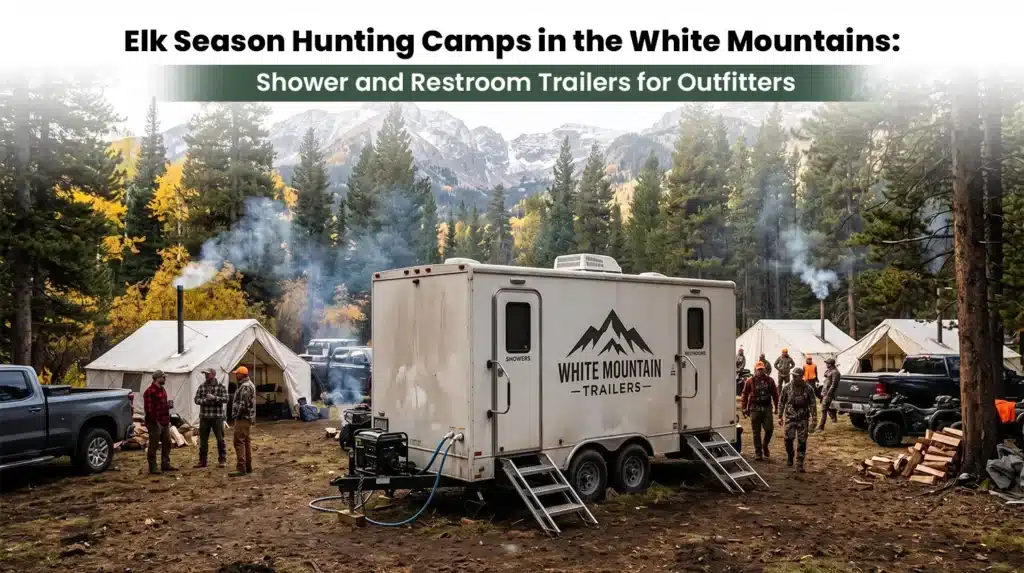

An RV park owner near the Mogollon Rim called us mid-season with a problem most campground operators eventually ran into: his permanent restroom and shower house was built for the park’s base capacity, but his overflow and tent sites had tripled his guest count for a holiday weekend. Building a permanent addition wasn’t realistic for a few peak weekends a year. What he actually needed was a way to add real capacity temporarily, without digging a new septic line or running new utilities across the property.
That’s the exact situation restroom and shower trailers solve well, whether it’s an RV park handling seasonal overflow or an off-grid community that never had municipal utilities to begin with. These trailers for RV parks and off-grid communities don’t depend on a site having power, water, or sewer already in place — and understanding how that self-contained capability actually works is what makes the difference between a temporary fix and a real solution.
Key Takeaways
- Modern restroom trailers can run fully self-contained, using onboard generators for power and onboard freshwater tanks instead of requiring a direct utility hookup.
- A standard garden hose spigot connection is often all that’s needed if potable water is available nearby, even if full electrical service isn’t.
- Off-grid units are specifically built with larger holding tanks and more robust onboard power systems for remote, unpredictable site conditions.
- Self-contained operation limits runtime and usage capacity compared to a direct hookup, so usage needs to be planned and monitored rather than treated as unlimited.
- RV parks typically need supplemental trailers most for seasonal overflow, special events, or site expansion before permanent utilities are in place — not as a permanent replacement for fixed facilities.
Why RV Parks and Off-Grid Communities Share a Common Problem
RV parks and off-grid communities look very different on the surface, but they run into the same core issue: existing or planned sanitation infrastructure doesn’t match actual demand at a given moment. An RV park’s permanent restroom and shower house is typically sized for its standard site count, which means any overflow weekend, special event, or seasonal surge outpaces capacity. An off-grid community, by definition, doesn’t have municipal water and sewer lines to tap into at all, so any sanitation solution has to work independently from day one.
In both cases, a supplemental restroom trailer solves the problem without a capital construction project — no new septic system, no new utility trenching, no permanent addition that only earns its cost during a handful of peak weekends or an early buildout phase.
How Self-Contained Operation Actually Works
This is the capability that makes these trailers viable for sites without existing infrastructure. Restroom trailers can run entirely without power or water hookups through a combination of onboard generators and onboard freshwater tanks, allowing full functionality — flushing toilets, running water at sinks, lighting, and in many units full climate control — exactly as it would with a direct utility connection.
Wastewater works the same self-contained way: trailers collect both grey water from sinks and black water from toilets in onboard holding tanks, which have finite capacity and need to be pumped out on a schedule once full, rather than draining into a fixed sewer line. For an RV park or off-grid site, this means the trailer itself becomes the entire sanitation system for its service period, with the only outside input being periodic refueling, water refilling, or tank pump-out visits.
When a Direct Hookup Still Makes Sense
Not every RV park or off-grid site is fully without infrastructure. If a site has a standard garden hose spigot or other potable water connection nearby, a trailer can often hook directly to it, which provides a continuous water supply without the need to monitor tank levels throughout the rental period. Similarly, sites with even limited electrical access — a single accessible circuit within roughly 100 feet of the trailer’s placement — can often run a trailer on direct power rather than relying solely on a generator.
This matters for planning: an RV park with partial infrastructure (water available, but not enough electrical capacity for new hookups, for example) doesn’t need a fully off-grid unit — it needs the right combination of self-contained and direct-connection capability for what the site actually has.
What to Know About Fully Self-Contained, Off-Grid Use
For sites with genuinely no utilities available, off-grid rental units are purpose-built for this kind of deployment, generally including larger holding tanks and more robust onboard power systems designed for performance in remote and unpredictable conditions. This is the right category to ask for specifically if your site is a true off-grid community or a remote section of a larger property with no plan to extend utilities to it.
The tradeoff worth understanding upfront: running in self-contained mode limits a trailer’s operating time and features compared to a direct hookup, since tank capacity and fuel both have finite limits. Usage needs to be monitored and refueling or refilling visits scheduled proactively during the rental period, rather than assumed to run indefinitely without attention. For more detail on how tank capacity and pump-out scheduling actually work, our guide on restroom trailer holding tanks and waste disposal covers the mechanics in depth.
Matching Trailer Size to RV Park Overflow vs. Off-Grid Community Needs
An RV park handling a holiday weekend overflow typically needs a short-term capacity boost — enough stalls to cover the temporary spike in guests, delivered and picked up around the peak period. An off-grid community, by contrast, may need facilities in place for a much longer stretch, whether that’s a seasonal camp, a construction phase before permanent facilities exist, or an ongoing supplemental need for a community that will remain off-grid indefinitely. Portable restroom trailers and portable shower trailers both come in a range of sizes, which makes it possible to match capacity to the actual use case rather than over- or under-sizing for either a short overflow weekend or a longer-term off-grid deployment.
Questions to Ask Before Booking for an RV Park or Off-Grid Site
- Does our site have any usable water or electrical access, even partial, or are we planning for fully self-contained operation?
- What’s the trailer’s realistic runtime on generator power and onboard water before refueling or refilling is needed?
- How often will holding tanks need to be pumped out given our expected usage volume?
- Is this a short-term overflow need, or an ongoing supplemental facility for a longer deployment?
- Does the unit size match our actual peak usage, or are we planning around an average that won’t hold up during busy periods?
Frequently Asked Questions
Can a restroom trailer really operate with no power or water hookup at all?
Yes. Modern restroom trailers can run fully self-contained using onboard generators for power and onboard freshwater tanks for water, providing the same functionality as a trailer connected to utilities, within the limits of tank and fuel capacity.
How do RV parks typically use supplemental restroom trailers?
Most commonly for seasonal overflow weekends, special events, or temporary capacity during a site expansion before permanent facilities are built. It’s rarely meant to permanently replace an RV park’s existing restroom and shower house.
What's the difference between a standard trailer and an off-grid-rated unit?
Off-grid units are built specifically for remote, utility-free deployment, typically with larger holding tanks and more robust onboard power systems designed to handle unpredictable conditions over a longer service period without support visits.
How often does a self-contained trailer need servicing?
It depends on usage volume and tank size, but self-contained operation requires more proactive monitoring than a direct-hookup unit, since both freshwater supply and waste tank capacity are finite. Discuss expected usage with your provider to set a realistic refill and pump-out schedule.
Is a direct hookup always better than a self-contained operation if it's available?
Generally yes, where available, since it removes the runtime limits that come with onboard tanks and generators. But for sites with no utility access at all, a well-matched self-contained or off-grid unit performs just as reliably within its planned usage limits.
Need Supplemental Facilities for an RV Park or Off-Grid Site?
Whether it’s a seasonal overflow weekend or an off-grid community with no utilities at all, the right trailer setup comes down to matching self-contained capability to your site’s actual conditions.
White Mountain Trailers has supported RV parks, campgrounds, and off-grid properties across Northern Arizona, from Flagstaff to Pinetop-Lakeside, for two generations, and we’ll help you figure out exactly what setup your site needs.
Call 928-358-8404 or visit wmtrailers.com to talk through your RV park or off-grid facility needs, or contact our team directly.