A ranch wedding client once asked us a question nobody thinks to ask until it’s too late: “Where does it all go?” She wasn’t being squeamish — she genuinely didn’t know how a restroom trailer works once the doors close and 150 guests start using it. It’s a fair question, and it’s one we hear constantly, usually right after someone’s already read the flooring options and the AC specs twice.
Holding tanks are the part of a restroom trailer nobody wants to think about, but they’re also the part that determines whether your event or job site runs smoothly for three days or turns into an emergency phone call on day two. Understanding how these tanks work — capacity, pump-out timing, black water versus grey water — isn’t optional homework. It’s the difference between a trailer that just works and one that shuts down mid-event.
Key Takeaways
- Restroom trailers hold wastewater in two separate systems: black water (toilets) and grey water (sinks and showers), and they fill at different rates.
- Tank capacity is usually rated in “flush events” or gallons, not calendar days — usage, not time, is what fills a tank.
- Most rental companies handle pump-out service directly or through a contracted septic partner; very few renters need to arrange this themselves.
- A tank that isn’t pumped in time doesn’t just get inconvenient — it can back up, shut down the unit, and end an event early.
What’s Actually Inside a Restroom Trailer’s Holding Tanks?
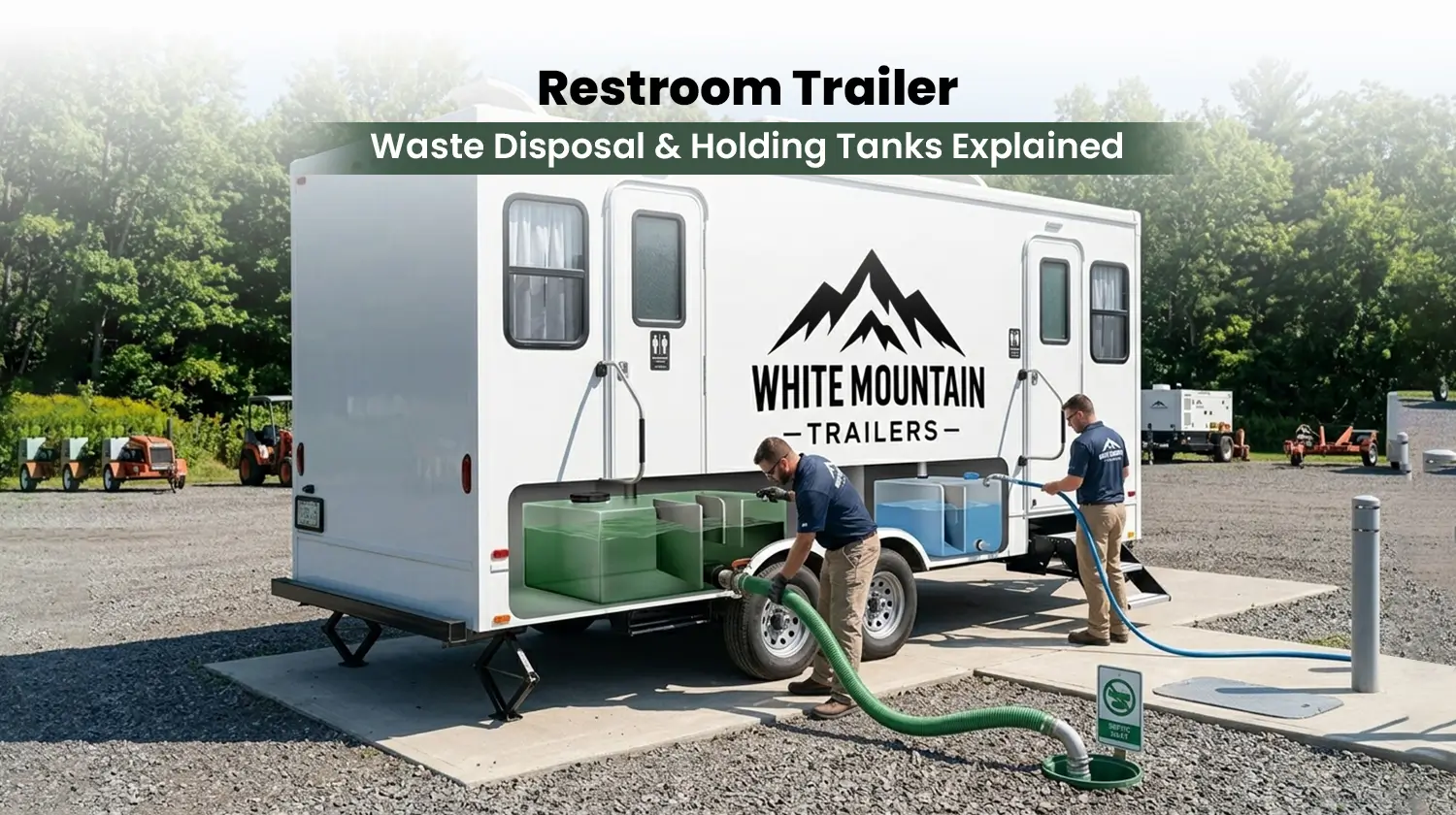
Every restroom trailer runs on a self-contained plumbing system built around two separate holding tanks. The black water tank collects toilet waste, while the grey water tank catches everything that drains from sinks and, in shower-equipped units, from the shower itself.
Keeping these separate matters for both odor control and pump-out efficiency. Blended systems exist on lower-end units, but production-grade and event-grade trailers almost always separate the two, because grey water is far less concentrated and can sometimes be handled differently by local disposal rules than black water can.
A trailer’s fresh water tank feeds the sinks and toilets, and it drains as the holding tanks fill, so the two systems are directly connected. Run out of fresh water, and the toilets stop flushing properly well before the black tank is technically full — which is why fresh water capacity and holding tank capacity need to be sized together, not separately.
How Big Are Restroom Trailer Holding Tanks, Really?
Holding tank sizes vary by trailer, but most event and production-grade units are built around tanks in the 300 to 500 gallon range for black water, with grey water tanks often sized similarly or slightly larger. Compare that to a typical RV, where black tanks commonly run between 18 and 64 gallons, with the largest fifth-wheel tanks reaching into the 80s (RVing Know How) — restroom trailers are built to handle far more traffic, and their tanks reflect that.
Capacity numbers only tell part of the story, though. What matters more is how a rental company translates gallons into “flush events” or “hours of heavy use,” since that’s the number that actually predicts when a tank needs servicing. A trailer with 400-gallon black water capacity might handle 800 to 1,000 flushes before needing a pump-out — plenty for a weekend event, potentially tight for a five-day job site with three shifts of workers.
Ask your rental company for their tank capacity in both gallons and estimated uses for your specific headcount. A number without that context doesn’t tell you much.
What Determines How Fast a Tank Fills?
Usage volume, not time, is what fills a holding tank — a trailer sitting empty for a week won’t need pumping, while the same trailer serving 300 people in six hours might need attention before the event even ends. As one industry guide on restroom trailer planning puts it, tanks have a finite capacity and must be pumped out when full to avoid overflow or shutdown, though a short one-day event under 100 guests typically won’t require any mid-event service (Portable Restroom Trailers).
A few factors shift that math in either direction:
- Headcount and duration together — more people over more hours means faster fill rates, and multi-day events compound the effect.
- Shower stalls, if the unit has them, since showers pull far more grey water per use than a sink does.
- Meal and beverage timing at events, since bathroom traffic spikes predictably around meals, toasts, and last calls.
- Job site shift patterns, where three shifts a day means three times the flush events of a single-shift crew.
Rental companies that plan for actual usage patterns, not just headcount, tend to avoid the mid-event surprises that headcount-only estimates miss.
Who Handles the Pump-Out — You or the Rental Company?
For the overwhelming majority of rentals, the rental company handles pump-out service directly or coordinates it through a contracted septic partner, and the renter never touches the tanks. Industry guidance for trailer operators confirms this is standard practice: the most common approach is having the waste tank pumped by a licensed septic company, often under a standing contract shared against the rental schedule (Lang Restroom Trailers).
For multi-day events or extended job site rentals, ask your provider directly how servicing works. Some include a set number of pump-outs in the rental price; others bill service calls separately. Neither approach is wrong, but you want to know which one you’re paying for before the invoice shows up.
Where possible, get the pump-out schedule in writing as part of your rental agreement, especially for job sites running six or more weeks. A verbal “we’ll keep an eye on it” isn’t a plan — a scheduled service date is.
Where Does the Waste Actually Go?
Once a tank is pumped, the waste doesn’t just disappear — it’s hauled by a licensed service to a treatment facility equipped to handle it. Portable sanitation waste is largely organic material that’s compatible with standard municipal treatment, and haulers typically follow mapped routes similar to commercial septic companies, with the treatment facility measuring, sampling, and logging each load before it’s accepted (MCS Portables).
This isn’t a loose, informal process. In states like Florida, servicing companies must hold an annual disposal permit specifically covering portable restrooms, restroom trailers, and holding tanks, and the permit application requires documentation of proper equipment before the state issues approval (Florida Administrative Code). Regulations vary state to state, but the underlying structure — licensed haulers, permitted facilities, logged loads — is consistent almost everywhere.
That paper trail matters more than most renters realize. If your job site or production is ever audited for environmental compliance, being able to show that waste was handled by a licensed, permitted service is part of the record you want on file.
What Happens If a Tank Isn’t Pumped in Time?
A tank that reaches capacity doesn’t fail quietly — toilets stop flushing cleanly, odor increases fast, and in worst cases, the unit backs up and needs to be shut down entirely until it’s serviced. On a job site, that’s an inconvenience. At a wedding reception or a film shoot with a locked schedule, it’s the kind of problem that ends up in the story guests or crew tell afterward.
The fix isn’t complicated: build in a buffer. If your rental company estimates a tank handles 800 flushes and you’re expecting 750, that’s not a comfortable margin — it’s a coin flip. Ask for a mid-event or mid-week pump-out as a standard part of the plan for anything longer than a single day or larger than a couple hundred guests, rather than waiting to see if you need one.
Questions to Ask Before You Book
A short, direct list of questions during booking prevents almost every holding tank problem before it starts:
- What’s the black water and grey water tank capacity, in both gallons and estimated flush events?
- Based on my headcount and event length, will I need a mid-event or mid-week pump-out?
- Does pump-out service come included, or is it billed separately?
- Who is your licensed septic partner, and are they permitted in this county or state?
- What’s the response time if a tank fills faster than expected?
A rental company with real experience should have straight answers to all five without needing to check with someone else.
Frequently Asked Questions
How often does a restroom trailer’s holding tank need to be pumped?
It depends entirely on usage, not a fixed schedule — a single-day event with fewer than 100 guests rarely needs mid-event service, while multi-day events or job sites with heavy daily traffic may need a pump-out every few days. Ask your rental company to estimate flush events against your specific headcount and duration.
What’s the difference between black water and grey water in a restroom trailer?
Black water comes from toilets and is more concentrated waste, while grey water comes from sinks and showers and is comparatively diluted. Restroom trailers keep these in separate holding tanks because they’re handled differently during servicing and because separation helps control odor.
Do I need to arrange my own septic service for a restroom trailer rental?
Almost never — most rental companies handle pump-out service directly or through a contracted, licensed septic partner as standard practice. Confirm before booking whether service is included in your rental price or billed as a separate call, especially for multi-day rentals.
Where does the waste from a restroom trailer go after it’s pumped?
Licensed haulers transport it to a permitted treatment facility, where the load is measured, sampled, and logged before acceptance, similar to standard municipal septic waste. In most states, servicing companies must hold a specific permit to handle portable restroom and restroom trailer waste.
What happens if a restroom trailer’s holding tank fills up during an event?
Toilets stop flushing properly, odor increases quickly, and in severe cases the unit has to be shut down until it’s serviced. Building in a mid-event pump-out for large or multi-day rentals, rather than waiting to see if one’s needed, is the simplest way to avoid this.
Planning a Rental and Not Sure What Tank Size You Need?
Holding tank capacity is one of those details that’s invisible right up until it isn’t — get it right, and nobody at your event or job site ever thinks about it. Get it wrong, and it’s the only thing anyone remembers.
White Mountain Trailers has outfitted events, job sites, and productions across Northern Arizona, from Flagstaff to Pinetop-Lakeside, for two generations. We’ll walk through your headcount, schedule, and location to size the right tanks and pump-out plan before you ever need to ask, “Where does it all go.”
Call 928-532-2434 or visit wmtrailers.com to talk through your rental’s waste disposal needs.