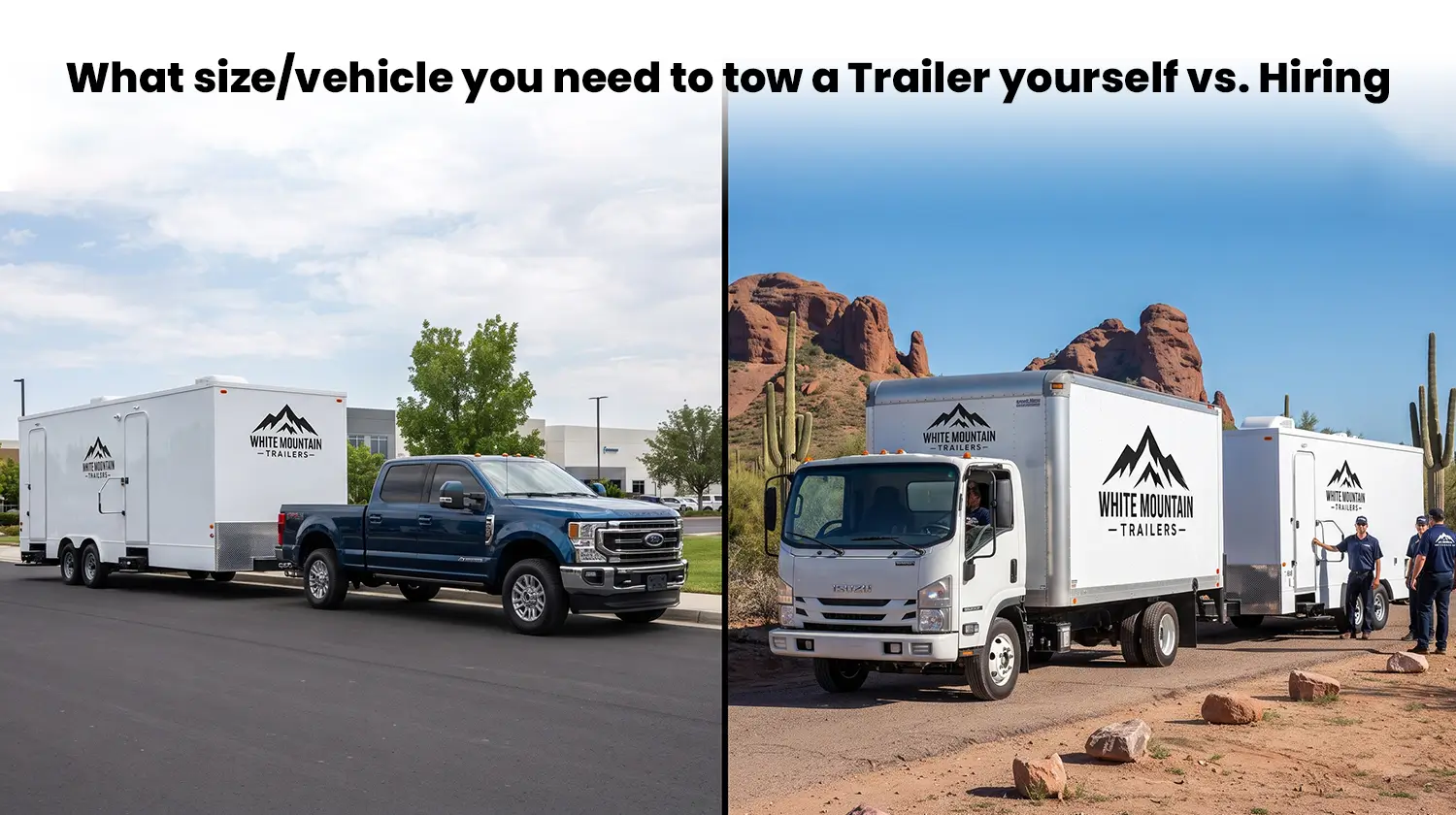
A contractor renting a restroom trailer for a weekend job once asked if he could just hook it to his half-ton pickup and save the delivery fee. He towed a similar-sized equipment trailer with that truck all the time, so it seemed like a reasonable ask. What he hadn’t accounted for was that his equipment trailer sat empty most of the time, while a restroom trailer’s actual road weight — once fresh water, waste tanks, and supplies are factored in — runs well past what his truck’s tow rating could safely handle.
That’s the gap that catches most people considering a self-tow: the trailer’s empty weight and its actual loaded, road-ready weight are two very different numbers, and only one of them matters for matching a tow vehicle correctly. Deciding whether to tow a restroom trailer yourself or hire delivery isn’t just about saving money — it’s about whether your vehicle, hitch, and license actually qualify for the job in the first place.
Key Takeaways
- A restroom trailer’s loaded weight is significantly higher than its empty weight once fresh water, grey water, waste, and supplies are factored in — size your tow vehicle to the loaded weight, not the trailer’s base specs.
- Your tow vehicle needs to match the trailer on several ratings at once: towing capacity, payload, axle rating, hitch weight, and gross combined weight — not just the single “towing capacity” number on a window sticker.
- A CDL generally isn’t required for personal, non-commercial towing regardless of weight, but commercial towing over certain combined weight thresholds does require one.
- Hitch class needs to match trailer weight — a hitch rated for a small utility trailer isn’t rated for a restroom trailer of meaningful size.
- For most renters, the delivery fee buys more than convenience — it buys a vehicle, hitch, and driver already matched to the trailer’s actual road weight.
Why “It Towed Fine in the Yard” Doesn’t Mean Much
The most common mistake in self-tow decisions is judging towing capability by how the trailer feels moving a short distance at low speed. A restroom trailer may be much heavier when its tanks are full — fresh water, grey water, and waste can add significant weight, and even supplies like paper products, cleaning materials, hoses, and steps add to the total load. Towing on public roads, hills, turns, and longer trips places far more demand on the vehicle, hitch, brakes, tires, and suspension than moving a trailer a few hundred feet around a lot ever will.
The tow vehicle has to be matched to the trailer’s actual loaded weight, not its empty weight and not a rough guess. This is the number that should drive every decision that follows — vehicle size, hitch class, and whether a CDL comes into play at all.
The Ratings That Actually Matter (Not Just “Towing Capacity”)
Most people look at a single number — towing capacity — and assume that’s the whole picture. In reality, a vehicle has separate ratings for payload, axle weight, hitch weight, and gross combined weight, and the trailer’s loaded weight needs to stay within all of them, not just the headline towing capacity figure. A truck can have plenty of towing capacity on paper and still be improperly matched if the hitch, axle rating, or payload capacity falls short once the actual load is accounted for.
This is why “my truck can tow X pounds” isn’t a complete answer. The honest question is whether your specific truck, with its specific axle ratings, hitch, and payload capacity, can handle this specific trailer at its actual loaded weight — and that requires checking your vehicle’s certification label and manufacturer towing guide, not just a general spec sheet.
Hitch Class: The Detail Most Self-Tow Plans Skip
Hitch classes are based on weight capacity, with lighter classes built for smaller loads and heavier classes built for larger trailers — and a specialty trailer like a restroom trailer often requires a stronger hitch than a typical small utility or landscaping trailer. A hitch rated for a light utility trailer isn’t automatically rated for a loaded restroom trailer, even if it physically bolts on and looks similar.
If you’re considering towing yourself, confirm your hitch’s actual rated capacity against the trailer’s loaded weight specifically — not the trailer’s empty weight, and not just “the hitch I already have installed.”
Do You Need a CDL to Tow a Restroom Trailer?
This is one of the more misunderstood parts of self-towing, and it depends heavily on whether the towing is personal or commercial. Under federal FMCSA rules, a Class A CDL is generally required when the tow vehicle’s gross combined weight rating exceeds 26,000 pounds and the trailer’s GVWR exceeds 10,000 pounds — but this threshold applies specifically to commercial operation, not personal use.
For personal, non-commercial towing, most states don’t require a CDL regardless of weight, as long as you’re not hauling for hire or as part of a commercial operation. Where this gets relevant for a restroom trailer specifically is if you’re a business towing the unit as part of paid operations — a rental company delivering to a client, or a contractor moving a company-owned trailer between job sites — since that context is more likely to be treated as commercial towing under state interpretation. If there’s any ambiguity about whether your specific situation counts as personal or commercial towing, checking with your state’s DMV or licensing authority directly is worth the five-minute call.
When Self-Towing Makes Sense
Self-towing can be a reasonable choice when your vehicle is genuinely rated for the trailer’s loaded weight, you already have towing experience with a similarly sized load, the trip is short and mostly highway or well-maintained roads, and you’re comfortable backing up and maneuvering a trailer of that size at the destination. Smaller restroom trailer units are more realistic candidates for self-tow than larger multi-stall units, simply because the weight and length gap is smaller relative to what a typical pickup can handle.
When Hiring Delivery Makes More Sense
Delivery is generally the better call when your vehicle’s ratings are close to or below the trailer’s loaded weight, you don’t have recent experience towing a trailer of this size, the destination involves a remote or difficult-access site, or the trip involves mountain grades, tight turns, or long highway stretches. For Northern Arizona specifically, elevation changes and mountain routes add real demand on brakes and towing systems that a lot of standard pickups aren’t built to handle repeatedly, even if they can manage it once.
There’s also a practical point worth being direct about: professional delivery crews tow these units regularly and know how to handle the specific weight distribution, backing, and placement challenges that come with a loaded restroom trailer. That experience has real value beyond just having the right-sized truck.
Questions to Ask Yourself Before Choosing Self-Tow
- What is the trailer’s actual loaded weight, not its empty or base weight?
- Does my vehicle’s towing capacity, payload, axle rating, and hitch class all clear that loaded weight, not just one of them?
- Is my hitch rated specifically for this trailer’s weight class, or just for lighter loads I’ve towed before?
- Does my trip involve mountain grades, tight access, or a long highway stretch I’m not experienced towing on?
- Is this towing personal use, or could it be considered commercial towing under my state’s rules?
Frequently Asked Questions
What size truck do I need to tow a restroom trailer?
It depends on the trailer’s loaded weight, not its empty weight — once fresh water, waste tanks, and supplies are factored in, the actual road weight is significantly higher than a trailer’s base specs suggest. Match your vehicle’s towing capacity, payload, axle rating, and hitch class against that loaded weight, not just the trailer’s listed empty weight.
Do I need a CDL to tow a restroom trailer?
Generally not for personal, non-commercial towing, regardless of weight. A CDL becomes relevant under federal rules when the tow vehicle’s gross combined weight rating exceeds 26,000 pounds and the trailer’s GVWR exceeds 10,000 pounds, primarily in a commercial context. If you’re towing as part of a business operation, check your state’s specific rules.
Is my current hitch strong enough for a restroom trailer?
Not necessarily. Hitch classes are rated by weight capacity, and a restroom trailer, especially a larger unit, often requires a stronger hitch than a typical utility trailer. Confirm your hitch’s rated capacity against the trailer’s actual loaded weight before assuming it will work.
Is it cheaper to tow a restroom trailer myself instead of paying for delivery?
It can save money upfront, but only if your vehicle is genuinely rated for the loaded weight and you’re comfortable towing and maneuvering a trailer of that size. An improperly matched tow vehicle risks damage, safety issues, or an inability to safely control the trailer, which can cost far more than the delivery fee would have.
Does towing a restroom trailer in Northern Arizona require anything special?
Nothing legally different from towing anywhere else, but mountain grades and elevation changes common throughout Northern Arizona place extra demand on brakes and towing systems. Factor route terrain into your decision, not just flat-ground towing capacity.
Not Sure If Your Vehicle Is Right for the Job?
Matching a tow vehicle to a restroom trailer’s actual loaded weight isn’t complicated, but getting it wrong has real consequences — for your vehicle, your trailer, and your safety on the road.
White Mountain Trailers has served renters across Northern Arizona, from Flagstaff to Pinetop-Lakeside, for two generations, and we’re happy to walk through your vehicle’s specs and help you decide whether self-tow or delivery is the right call for your rental.
Call 928-358-8404 or visit wmtrailers.com to talk through your pickup or delivery options.
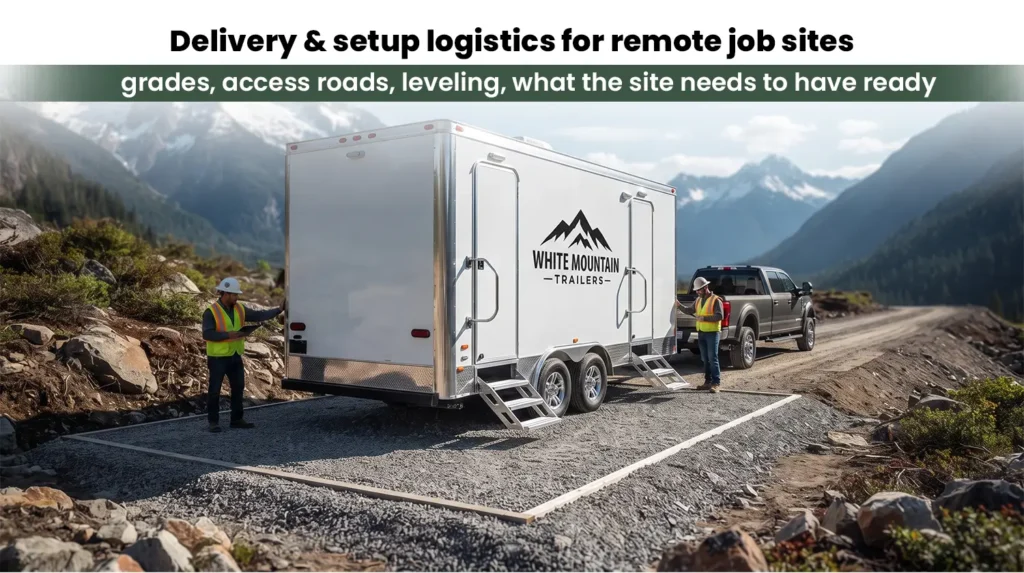
How wide does our access road need to be for restroom trailer delivery?
Generally at least 10 feet wide to accommodate the delivery truck and trailer together, with at least 12 feet of overhead clearance along the route. Narrower roads or lower clearances should be flagged to your rental company before delivery day.
Can a restroom trailer be delivered on an unpaved or gravel road?
Yes, in most cases. Compacted gravel is considered a strong alternative to pavement, since it offers good drainage and stability. Soft, sandy, or muddy unpaved roads are the bigger concern, especially after rain.
What happens if our site isn't level?
Minor grades can usually be corrected with leveling blocks or jacks. Steep slopes generally can’t be leveled on-site and may require choosing a different placement spot on the property.
Does a remote job site need power and water hookups for a restroom trailer?
Not necessarily. Many units run on self-contained systems with onboard water tanks and generator power, which makes them workable on sites with no permanent utilities at all. Confirm with your rental company which setup your specific unit uses.
What's the best way to prepare for delivery to a hard-to-reach site?
Send your rental company photos of the access route ahead of time, and flag anything unusual — narrow roads, gates, soft ground, or slopes — before delivery day rather than during it. For genuinely remote sites, a phone walkthrough or site survey ahead of time is worth the extra step.
Planning a Delivery to a Remote Job Site?
Getting a restroom trailer to a hard-to-reach site isn’t complicated once the access, ground, and leveling details are sorted out ahead of time — the problems only show up when nobody checks in advance.
White Mountain Trailers has delivered and set up restroom, shower, and sink trailers across remote job sites throughout Northern Arizona, from Flagstaff to Pinetop-Lakeside, for two generations. Send us photos of your access route and we’ll tell you exactly what to have ready before our truck shows up.
Call 928-358-8404 or visit wmtrailers.com to plan your remote job site delivery.