When a natural disaster, structural collapse, or high-security crisis occurs, municipal agencies and public safety departments face immediate logistical challenges. In the critical opening minutes of an incident, field operations are often compromised by collapsed cellular networks, fragmented coordination, and a lack of centralized workspace.
Relying on makeshift field bases like the hood of a vehicle or a temporary pop-up tent invites operational confusion. High-stakes incident management requires an environment that isolates decision-makers from chaotic external elements, secures sensitive data streams, and maintains continuous communication links.
Deploying heavily reinforced, custom-engineered emergency command trailers transforms how incident commanders manage chaotic environments. These specialized assets provide tactical teams with a mobile, highly stable operations base designed to maintain order under extreme conditions. Here are nine smart ways custom command trailers optimize critical field operations.
1. Establishes an Immediate, High-Visibility Tactical Hub
When multiple public safety departments—such as local police forces, county fire crews, and federal emergency teams—converge on a disaster site, a lack of clear layout leads to fragmented communications. Field operations become chaotic without an obvious, centralized point of authority.
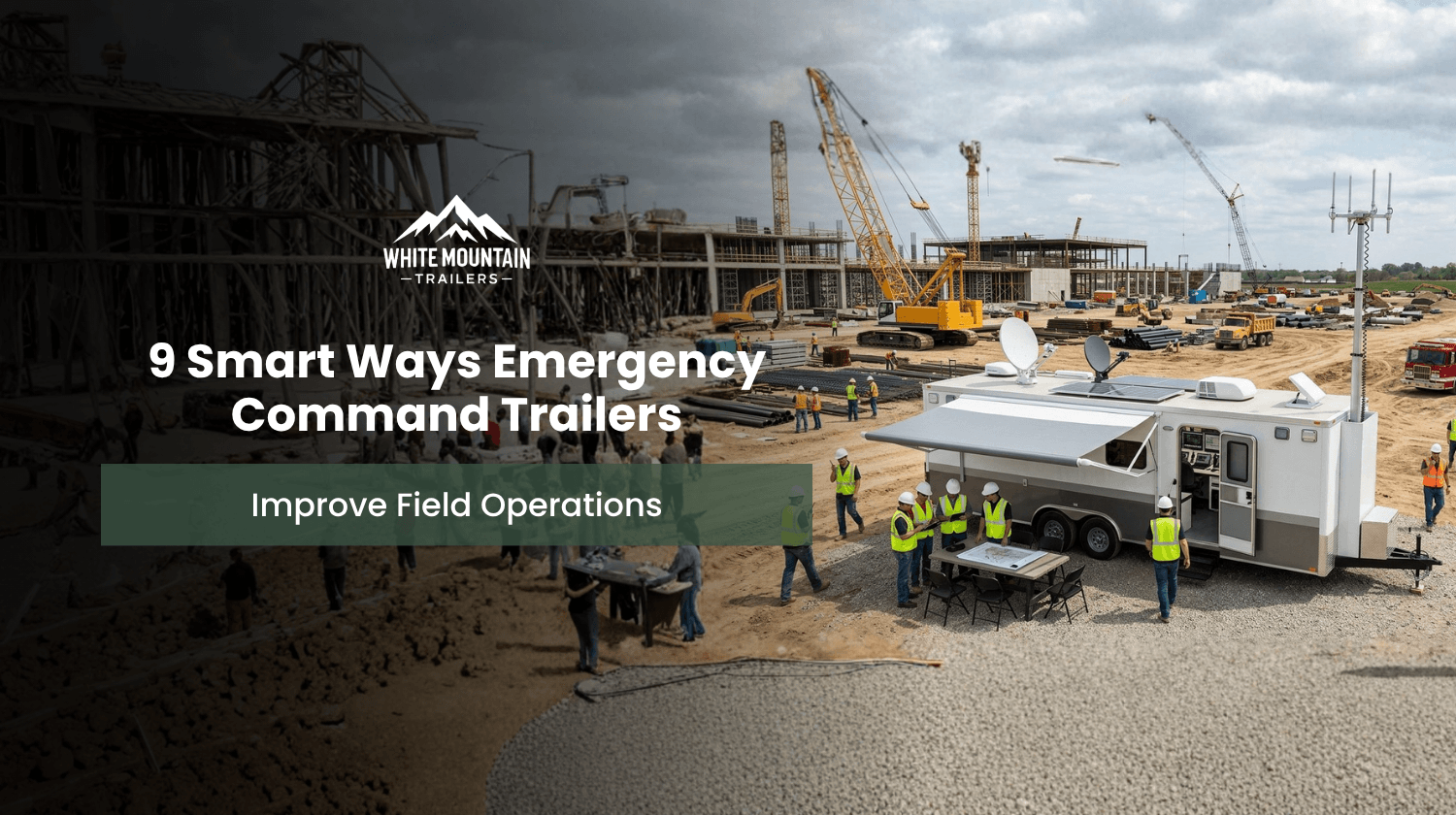
A rugged mobile command center trailer serves as a distinct tactical landmark. Its heavy-duty exterior lighting, specialized graphics, and tall telescopic mast systems make it instantly visible across a sprawling footprint. This clear point of coordination ensures all incoming personnel can locate the incident commander immediately, speeding up team deployment.
2. Guarantees Uninterrupted Communication with Satellite Arrays
A major hurricane, tornado, or cyber incident can wipe out local cellular towers and fiber networks instantly. If your incident management team loses real-time contact with dispatch centers and hospitals, your team’s situational awareness drops to zero.
Elite emergency communication trailers feature roof-mounted satellite dishes (such as automated auto-acquire VSAT or high-bandwidth low-Earth-orbit arrays), multi-carrier 5G cellular routers, and cross-band radio interoperability systems. This advanced architecture ensures your team maintains robust voice, video, and data links even if local telecom grids are completely down.
3. Protects Critical Electronics Using Clean, Automated Power Loops
Field equipment—such as tactical computers, thermal imaging drones, and radio repeaters—requires a steady, clean electrical feed. Running sensitive IT gear off standard, unconditioned commercial generators risks exposing your equipment to voltage spikes that can fry your vital communication lines.
Premium emergency response trailers integrate complex, redundant power grids. These systems combine internal, whisper-quiet diesel generators with intelligent power conditioners and high-capacity uninterruptible power supplies (UPS). If the generator requires maintenance, the UPS backup system keeps your screens and communication lines running without a single second of data dropout.
Field Logistics: Tactical Command Trailers vs. Temporary Incident Tents
Operational Metric | Standard Pop-Up Incident Tents | Custom Emergency Command Trailers |
Deployment Speed | Slow (Manual assembly, wiring, and component linking) | Fast (Park, extend stabilizing jacks, and press power) |
Climate Regulation | Poor (Vulnerable to extreme cold, high heat, and wind) | Excellent (Insulated walls with multi-zone commercial HVAC) |
Data Protection | Vulnerable (Exposed cabling, no physical access security) | Secure (Interlocking steel doors, enclosed electronic racks) |
Acoustic Isolation | None (Siren and engine noise disrupt radio traffic) | Complete (Sound-dampened meeting rooms for clear comms) |
4. Isolates Strategic Decision Makers via Dual-Zone Interiors
Managing a crisis requires two distinct operational tracks: fast-paced tactical dispatching and quiet, long-term strategic planning. Forcing radio operators, drone pilots, and agency chiefs into a single, crowded space creates a chaotic environment that hurts decision-making.
Modern emergency management trailers solve this by utilizing intelligent dual-zone interior floor plans.
- The Forward Zone: Dedicated to high-tempo operations, featuring multiple sit-stand workstations, multi-screen video walls, and radio consoles for active monitoring.
- The Aft Zone: Configured as an acoustically isolated briefing room with a central conference table and secure screens. This layout allows leadership to analyze data maps and brief officials without radio traffic noise.
5. Captures Real-Time Air Video Feed for Complete Situational Awareness
Without a real-time, bird’s-eye view of a dynamic threat—such as a fast-moving wildfire perimeter or a fluid tactical incident—commanders are forced to make safety choices based on delayed radios.
Custom disaster response trailers integrate heavy-duty pneumatic or hydraulic aluminum mast poles capable of raising thermal pan-tilt-zoom (PTZ) cameras, weather tracking sensors, and long-range radio antennas up to 50 feet in the air. Furthermore, the interior workstations can integrate real-time video downlinks directly from overhead surveillance drones, providing an immediate visual picture of the operational area.
6. Delivers Total Off-Grid Operational Autonomy
Disaster zones often present severe environmental hazards, including a total lack of clean drinking water, live electrical lines, and climate-controlled shelter. If your command team has to leave the site to refuel or find rest areas, your operational momentum stalls.
A fully self-contained mobile emergency trailer is engineered to act as an independent tactical island for days at a time. Equipped with large onboard fuel reservoirs, spacious freshwater bladders, and integrated greywater containment systems, these platforms keep your operations running smoothly through extended deployments without requiring outside support.
7. Accelerates Deployment Times Using Rapid Response Design
During a crisis, time is your most scarce resource. Setting up folding tables, running long spools of extension cords, and manually linking radio equipment slows down your team’s deployment when minutes matter.
Premium rapid response trailers are designed around a turn-key operational model. All vital components—including network servers, display matrices, and radio base stations—are hardwired and securely shocked-mounted into commercial electronic racks. Once on the scene, a single operator can deploy the stabilizing jacks, start the generator, and bring the entire command hub online in under ten minutes.
8. Provides Heavy Duty Climate Control for Extreme Weather Resilience
Operating inside extreme weather environments—such as freezing winter storms or brutal triple-digit summer heatwaves—drains the focus and stamina of your field team. Prolonged exposure to extreme heat can also cause your processing servers and communication electronics to overheat and fail.
Professional crisis response trailers use commercial-grade, multi-zone HVAC cooling and heating arrays paired with thick r-value spray foam insulation throughout the chassis walls. This ensures a comfortable, climate-controlled workspace for your operators while protecting your server racks from overheating during intense summer field operations.
9. Safeguards Critical Field Data with Physical Access Controls
A field incident base can quickly become a busy environment filled with visiting contractors, volunteers, and media personnel. If your sensitive data feeds, maps, and tactical assets are left out in the open, you run a high risk of data breaches or security issues.
Custom-engineered emergency operations trailers feature commercial physical defense upgrades. These additions include heavy-duty entry doors with digital keypad locks, locking electronic enclosures, and internal CCTV networks that monitor the trailer’s perimeter. This security framework ensures only authorized personnel can access your mission-critical data systems.
Frequently Asked Questions
What class of driver's license is required to tow a command trailer?
Most mid-sized emergency support trailers under 26,000 lbs Gross Vehicle Weight Rating (GVWR) can be towed safely without a commercial driver’s license (CDL). However, your agency must ensure the tow vehicle’s rating matches the trailer’s weight and that your drivers are trained in heavy-duty hitch mechanics and braking dynamics.
Can command trailers be customized for specific law enforcement or fire tasks?
Yes, absolutely. Professional fabricators use modular blueprints to tailor your layout to your exact operational focus. A police unit might include evidence lockers and interview spaces, while a fire department variant can feature dedicated display screens for topography and active weather mapping software.
How do command trailers stay level on uneven, debris-covered ground?
Commercial mobile command units use heavy-duty hydraulic or electric stabilizing jacks mounted directly to the steel frame. Operators can control these jacks via a central panel to level and stabilize the trailer on unpaved terrain, mud, or debris-filled incident zones.
What are the advantages of slide-out side walls on an incident trailer?
Integrating automated hydraulic slide-out rooms expands your interior floor space significantly once parked on-site. This extra width allows for wider interior walking paths, larger briefing tables, and additional data workstations without exceeding standard legal towing widths on the highway.
Upgrade Your Agency’s Incident Command Infrastructure
Relying on outdated equipment or temporary field setups compromises the safety of your personnel and slows down critical response times when lives are on the line. Upgrading your response capabilities with a custom-engineered first responder trailer secures your communications, keeps your data organized, and provides your leadership team with a resilient base designed to withstand any emergency. By partnering with a dedicated fabrication team to build your mobile command systems, you ensure your agency is fully prepared to take control of any crisis.
Ready to enhance your tactical field capabilities? Visit our Emergency Command Trailers Specification Page today to explore our structural blueprints, review our past deployments, and schedule a configuration consultation with our public safety engineering team!