A corporate event planner once called us the week before a 400-guest company picnic, relieved she’d already checked the accessibility box — her restroom trailer vendor had told her the unit had “a wider door and a grab bar,” so she assumed that covered it. It didn’t. When we walked through the actual requirements with her, it turned out the trailer she’d booked had neither the turning radius nor the required unit ratio for her guest count, and she had four business days to fix it before the event.
That gap between “sounds accessible” and “actually ADA-compliant” is more common than most renters realize, partly because a lot of vendors use the word loosely. A door that’s a few inches wider than standard isn’t automatically ADA-compliant, and a single grab bar bolted to a wall doesn’t satisfy the standard either. Knowing exactly what qualifies — and just as importantly, what doesn’t — is the only way to avoid finding out the hard way, days before an event or during a job site inspection.
Key Takeaways
- ADA-compliant restroom trailers follow the 2010 ADA Standards for Accessible Design, which specify exact dimensions for doors, interior clearance, fixture height, and grab bar placement — not general “wheelchair-friendly” features.
- The federal baseline requires roughly 5% of single-user portable units at a cluster to be ADA-accessible, with a minimum of one unit wherever portable restrooms are provided at all.
- Placement matters as much as the unit itself — an accessible unit tucked far from the main restroom bank doesn’t provide equivalent access, even if the unit itself is fully compliant.
- Construction sites providing two or more toilet units generally need at least one ADA-compliant unit among them.
- Some states and municipalities layer additional requirements on top of the federal ADA baseline, so a compliant unit in one location isn’t automatically compliant everywhere.
What Actually Makes a Restroom Trailer ADA-Compliant
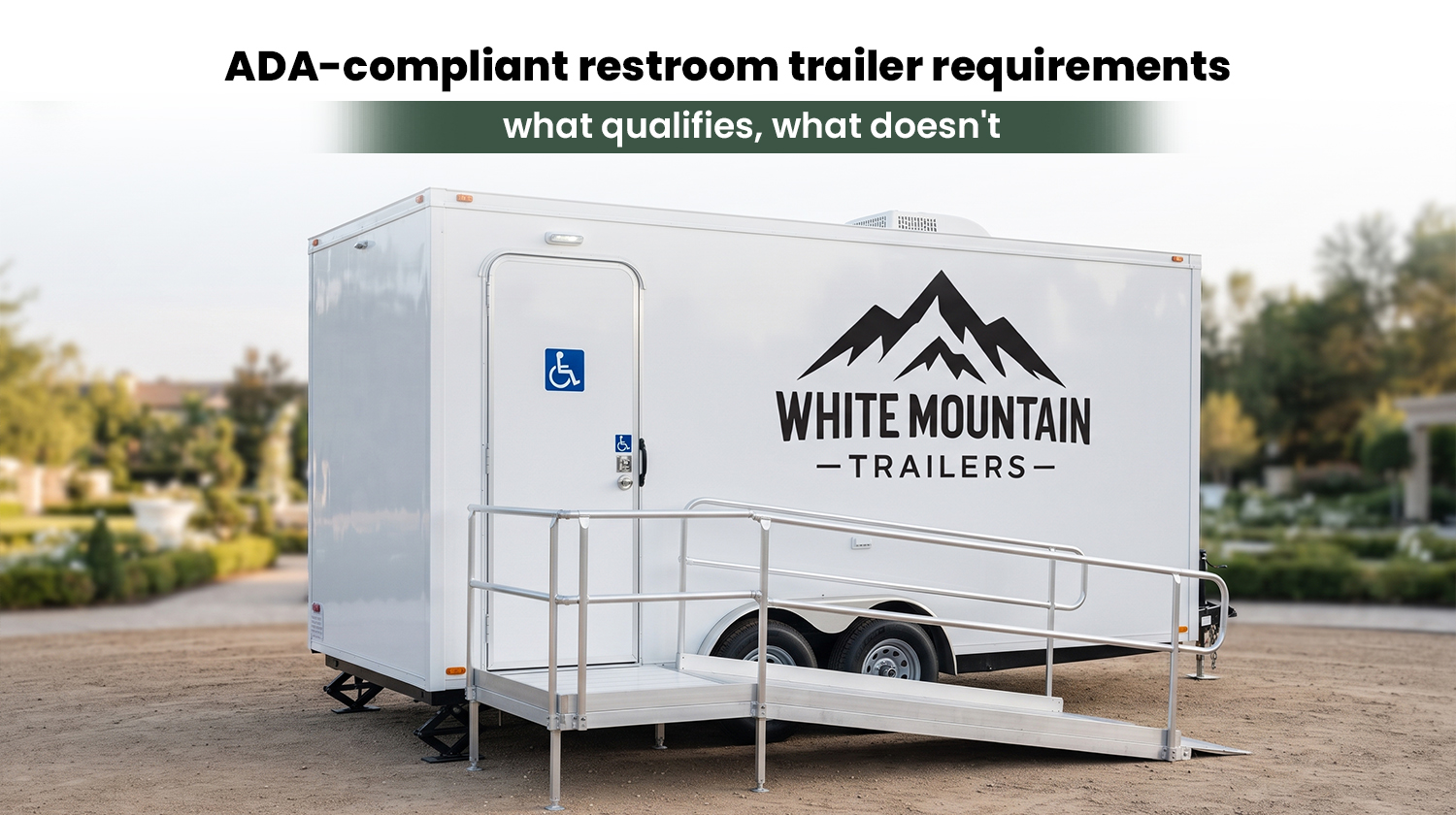
An ADA-compliant restroom trailer isn’t defined by a general impression of accessibility — it’s defined by specific measurements. The 2010 ADA Standards for Accessible Design set exact requirements for entry width, interior turning space, fixture height, hardware operation, and signage, and a unit either meets those dimensions or it doesn’t. There’s no partial-credit version of ADA compliance that satisfies the standard.
This is the detail that trips up renters most often: a trailer can look accessible — a ramp, a slightly wider door, a bar near the toilet — without actually meeting the dimensional requirements underneath. Ask any vendor claiming ADA compliance for the specific measurements, not just a description of features.
The Dimensions That Actually Qualify
A genuinely ADA-compliant restroom trailer needs to meet several concrete specifications at once:
- Door width: A minimum clear width sufficient for wheelchair passage, with easy-operating lever-style hardware rather than a twist knob.
- Interior turning space: Enough clear floor space inside the stall for a wheelchair to make a full turn — this is usually the single biggest difference between a “wide door” unit and a truly accessible one.
- Toilet height and position: Seat height and the toilet’s distance from the side wall fall within a specific measured range, not just “roughly standard height.”
- Grab bars: Positioned at specific locations and heights near the toilet for stability and transfer support, not just present somewhere in the stall.
- Flush controls and hardware: Operable with one hand and without tight grasping, pinching, or twisting.
- Sink height and clearance: Mounted low enough and with enough knee clearance for wheelchair users to reach comfortably.
- Signage: Raised letters, Grade 2 Braille, and high-contrast finishes, mounted at a specific height beside the door latch, along with the International Symbol of Accessibility.
Missing any one of these doesn’t make a unit “mostly compliant” — it makes it non-compliant, full stop.
How Many ADA Units Do You Actually Need?
This is where a lot of event planners get caught off guard, much like the picnic organizer in our opening story. The federal baseline generally works out to about 5% of single-user portable units at a cluster needing to be ADA-accessible, with a minimum of one accessible unit wherever portable restrooms are provided at all — even if your total unit count is small enough that 5% rounds down to nothing.
For construction sites, a similar principle applies from a different angle: once a site provides two or more toilet units, at least one of them generally needs to be ADA-compliant. A single-unit job site with only one toilet doesn’t trigger the same requirement the way a multi-unit setup does, but the moment you add a second unit, accessibility needs to be part of the plan.
Placement Counts Just as Much as the Unit Itself
Here’s the part almost nobody talks about: having a compliant unit on-site isn’t enough if it’s placed somewhere that undermines equal access. Accessible units need to sit at comparable distance and convenience to the primary restroom bank — not off in a corner, behind equipment, or at the far edge of a parking lot while standard units cluster near the main event space.
An accessible unit that requires significantly more travel to reach than a standard unit isn’t providing equivalent access, even if the unit itself checks every dimensional box. Keep the clear path to it free of fencing, vehicles, cords, or construction materials, and make sure lighting reaches it the same way it reaches everything else — this matters especially for evening events and job sites running into low light.
When State or Local Rules Go Beyond the Federal Standard
The federal ADA Standards are the baseline everywhere, but some states and municipalities add their own dimensional or ratio requirements on top of it. A unit that’s fully compliant with the federal standard in one location isn’t automatically compliant somewhere with a stricter local code layered over it. If you’re planning an event or job site outside the immediate area you usually work in, it’s worth a quick check on whether local rules add anything beyond the federal minimum before you finalize your unit count.
Questions to Ask Before You Book an ADA Unit
- What specific dimensions — door width, turning radius, toilet height — does this unit actually meet, not just what features does it have?
- How many ADA-compliant units does my guest count or crew size actually require?
- Where will the accessible unit be placed relative to the rest of the restroom bank?
- Does this location have any state or local accessibility requirements beyond the federal ADA baseline?
- Can you provide compliance documentation if this is for a government contract, permit, or RFP?
Frequently Asked Questions
What's the difference between a "wide door" restroom trailer and an ADA-compliant one?
A wider door alone doesn’t make a unit ADA-compliant. True compliance requires specific interior turning space, fixture heights, grab bar placement, and hardware type all meeting exact measurements together — a wide door with a standard-height toilet and no proper turning radius still fails the standard.
How many ADA-compliant restroom trailers do I need for my event?
The federal baseline generally requires about 5% of single-user portable units to be accessible, with a minimum of one unit no matter how small the total count is. Larger events or venues with stricter local requirements may need more than the federal minimum.
Do construction sites need ADA-compliant restroom units?
Generally, yes, once a site provides two or more toilet units — at least one typically needs to be ADA-compliant. A site with only a single unit falls under different rules than one running multiple units for a larger crew.
Does the placement of an ADA unit matter, or just the unit itself?
Placement matters. An accessible unit needs to be positioned at comparable distance and convenience to the rest of the restroom bank, with a clear, unobstructed path. A compliant unit placed far from the main facilities doesn’t provide equivalent access.
Are ADA restroom trailer requirements the same in every state?
The federal ADA Standards apply everywhere as the baseline, but some states and municipalities add stricter dimensional or ratio requirements on top. Always confirm local requirements in addition to the federal standard for events or job sites outside your usual area.
Planning an Event or Job Site and Need to Get Accessibility Right?
ADA compliance isn’t about finding a trailer that looks accessible — it’s about confirming the actual measurements, the right ratio for your headcount, and placement that gives every guest or worker equal access.
White Mountain Trailers has outfitted events and job sites across Northern Arizona, from Flagstaff to Pinetop-Lakeside, for two generations. We’ll walk through your guest count or crew size and make sure your ADA unit — and its placement — actually meets the standard before your event or project starts.
Call 928-358-8404 or visit wmtrailers.com to talk through your accessibility requirements.