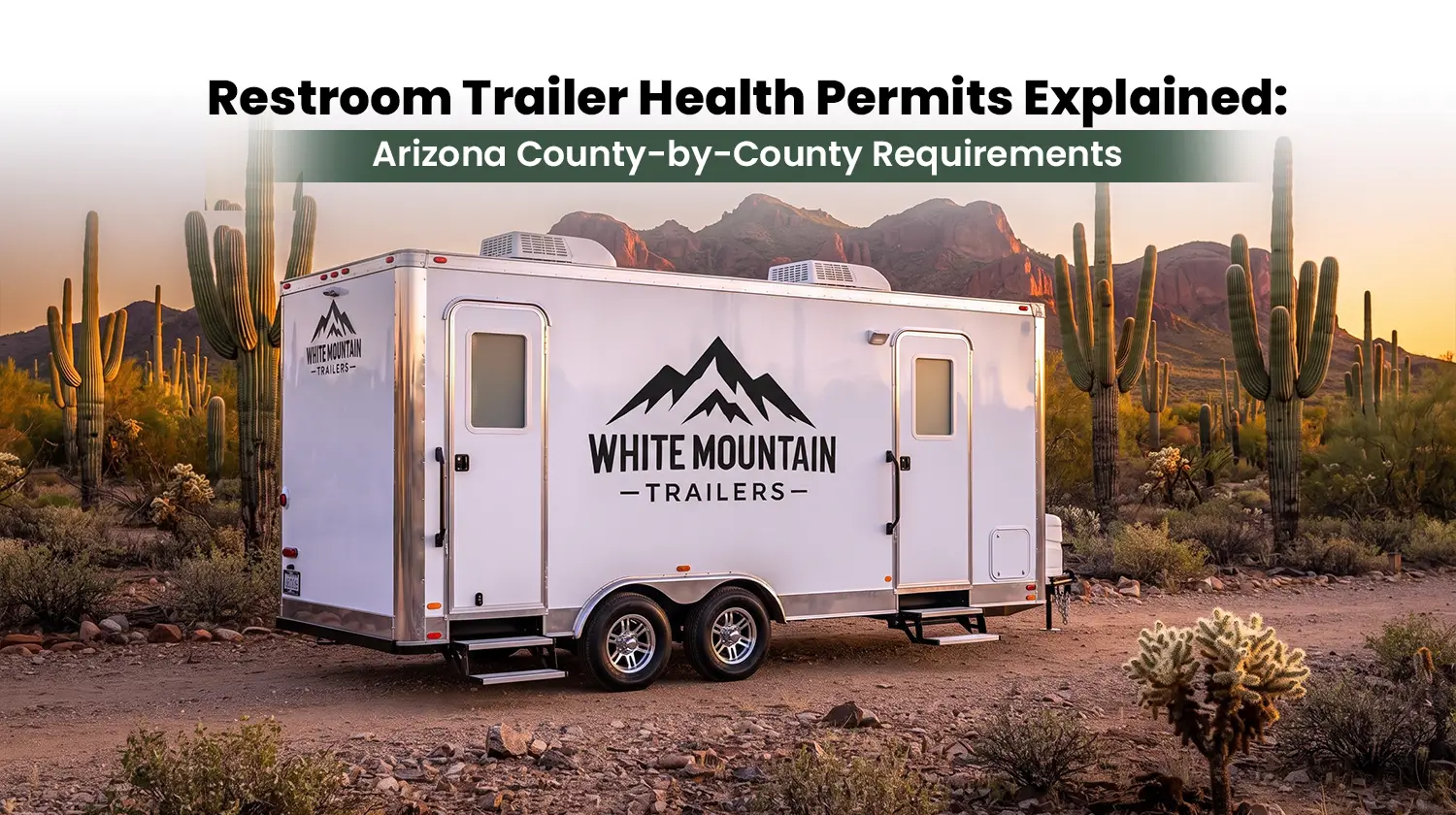
A job site foreman outside Show Low once called us two days before a six-week highway project was set to start, asking if we could “just drop the restroom trailer off Monday morning.” We could — but we also asked whether the county had signed off on the site’s sanitation plan yet. Silence on the other end told us the answer. The project got its trailer on time, but only because someone finally called the county that same afternoon instead of assuming a rental agreement was the only paperwork that mattered.
That mix-up is more common than it should be. Restroom trailer health permits in Arizona aren’t hard to get, but they’re also not automatic, and they don’t come bundled with the rental itself. Knowing what triggers a permit, which county office actually issues it, and how long it takes is the difference between a trailer that shows up and gets used, and one that shows up and sits there while an inspector gets looped in.
Key Takeaways
- Arizona doesn’t have one statewide restroom trailer health permit — each county’s health department issues and enforces its own, operating under delegated authority from the Arizona Department of Health Services.
- What triggers the permit is usually the event or project type — public gatherings, food vendors, campgrounds, and job sites are far more likely to need one than a private backyard event.
- Navajo, Apache, Coconino, and Gila County each route restroom trailer health permits through a different office, with different lead times and slightly different categories.
- Waste hauling and pump-out service falls under a separate permit track entirely — a septage hauler license — which is almost always the rental company’s responsibility.
What Actually Counts as a “Restroom Trailer Health Permit” in Arizona?
There’s no line item on any Arizona county’s permit list that reads “restroom trailer permit.” Instead, restroom trailers get pulled into existing categories — temporary event permits, food establishment permits (if food is served nearby), trailer coach park permits, or campground permits — depending on what the trailer is supporting.
That’s the part that trips people up. A restroom trailer at a private wedding with no food vendors might need nothing at all. The same trailer at a public festival with food trucks almost certainly falls under a temporary event health permit, because the food vendors themselves are what pull county environmental health into the picture — and once they’re involved, sanitation facilities get reviewed as part of the same plan.
The Delegation System Behind Every County’s Rules
All four counties covered here operate under a delegation agreement with the Arizona Department of Health Services, meaning ADHS sets the underlying code, and the county health department is the one that actually reviews plans, issues permits, and shows up to inspect. This matters practically: calling the state won’t get your event or job site permitted. Calling the right county office will.
It also means the rules are broadly consistent statewide, even when the process — application forms, lead times, which office handles what — varies county to county. Treat each county as its own process, even for identical events.
Navajo County Restroom Trailer Health Permits
The Navajo County Department of Environmental Health issues permits covering food establishments, hotels and motels, trailer coach parks, campgrounds, and temporary and mobile food units, along with oversight of water and wastewater haulers. If your restroom trailer is supporting an event with food service, or sits within a campground or trailer coach park classification, Navajo County’s office is the one reviewing it — not the state, and not a neighboring county, even if your event feels closer to another town.
Permits here must be posted at the facility once issued, and applications generally route through the Holbrook or Show Low offices depending on event location.
Apache County Restroom Trailer Health Permits
Apache County Public Health Services District handles this through its Division of Environmental Services, which covers wastewater and onsite sewage plan review, public accommodation inspections, camps, and nuisance complaints — all under its own ADHS delegation. Restroom trailer health permits here lean heavily on the wastewater side, since onsite sewage system plan review is a core function of the division, which ties directly into how holding tank service and disposal get evaluated for your event.
One wrinkle specific to Apache County: land near the Navajo Nation or Fort Apache Reservation boundaries can fall under separate tribal environmental health jurisdiction instead of the county. If your venue is anywhere near those lines, confirm jurisdiction before applying anywhere.
Coconino County Restroom Trailer Health Permits
Coconino County Health and Human Services (CCHHS) enforces the county’s Unified Health Code, which covers food establishments, campgrounds, and RV and trailer coach parks. For public events, the county requires a designated Special Event Coordinator and applications submitted at least 14 business days in advance — one of the few counties with a clearly published lead time, and a useful benchmark even where other counties don’t state one outright.
Coconino County also splits its environmental authority: health permits for events run through CCHHS, while onsite wastewater and septic permitting runs through a separate Environmental Quality division operating under delegation from the Arizona Department of Environmental Quality (ADEQ), not ADHS. Two different offices, two different delegating agencies — worth knowing before you call the wrong one.
Gila County Restroom Trailer Health Permits
Gila County Environmental Health Services, under the county’s Health & Community Services department, manages plan review, permitting, and inspection for food establishments, public accommodations, and temporary and mobile food vendors. As with the other counties, a restroom trailer health permit in Gila County is typically triggered by the event category — food service, camping, public accommodation — rather than the trailer being licensed on its own.
Gila County stretches from Globe-Miami up through Payson and Rim Country, so confirm which service center covers your event’s specific location; it isn’t always the office closest to the county seat.
Trailer Coach Park and Septage Hauler Permits: The Other Two Categories
Two related permits show up often enough to call out separately. If your restroom trailer is part of a broader RV park, campground, or multi-trailer encampment rather than a single-day event, a trailer coach park permit is the relevant category in all four counties, and it’s a different application than a standard event health permit.
The septage hauler permit is the one that actually governs day-to-day servicing. Whoever pumps and hauls a restroom trailer’s holding tanks needs a valid wastewater hauler license in the county where the waste is collected. This is standard practice for established rental companies and almost never something the renter arranges personally — but for job sites using subcontracted haulers, it’s worth a direct confirmation.
Who Actually Applies for the Permit?
For most private events, nobody personally files anything — the rental company either holds standing permits for its own equipment and hauling, or advises on what the event itself needs. For public events, food-vendor gatherings, or extended job sites, the event organizer, property owner, or general contractor is usually the one filing the event-level permit, while the rental company’s permits cover only its own operation.
Don’t let this stay a verbal assumption. Ask directly, in writing, who is filing what and by when — especially for anything with a fixed start date that can’t slip.
Questions to Ask Before You Book
- Does my event or job site actually trigger a county health permit, or does it fall outside that requirement entirely?
- Which county has jurisdiction, particularly if the site sits near a county or tribal land boundary?
- Does the rental company hold a current septage hauler permit for this county?
- What’s the actual lead time for this county’s application — a fixed number of days, or does it vary?
- If food vendors are added later, does that change which permit category applies?
Frequently Asked Questions
Does every restroom trailer rental in Arizona need a health permit?
No. Private events without food vendors or public admission often need nothing at all. Public events, food-vendor gatherings, campgrounds, and trailer coach park setups are the situations most likely to require a county health permit.
Which office issues the permit — the state or the county?
The county. Arizona Department of Health Services delegates enforcement authority to each county’s health department, so permits are reviewed and issued locally, not by the state directly.
How long does it take to get a restroom trailer health permit in Arizona?
It varies by county. Coconino County requires special event applications at least 14 business days ahead; other counties don’t publish a fixed minimum, but two to three weeks is a reasonable planning window regardless.
What happens if my event is near a county line?
Jurisdiction follows the event’s actual physical location, not the nearest town people associate with it. Venues near the Navajo-Apache line or reservation boundaries should confirm jurisdiction directly with the county before applying.
Is the rental company or the renter responsible for the health permit?
It depends on the event. Rental companies typically hold their own equipment and hauling permits, while event-level health permits for public gatherings usually fall to the event organizer or property owner. Confirm this directly before signing a rental agreement.
Not Sure What Your Event or Job Site Needs?
Health permit requirements sound complicated until you know which office to call and what actually triggers one — and that’s usually a five-minute conversation, not a research project.
White Mountain Trailers has supported events and job sites across Navajo, Apache, Coconino, and Gila County for two generations. Tell us about your event or project, and we’ll help you figure out exactly what — if anything — needs a county sign-off before your trailer arrives.
Call 928-358-8404 or visit wmtrailers.com to talk through your permit and rental needs.