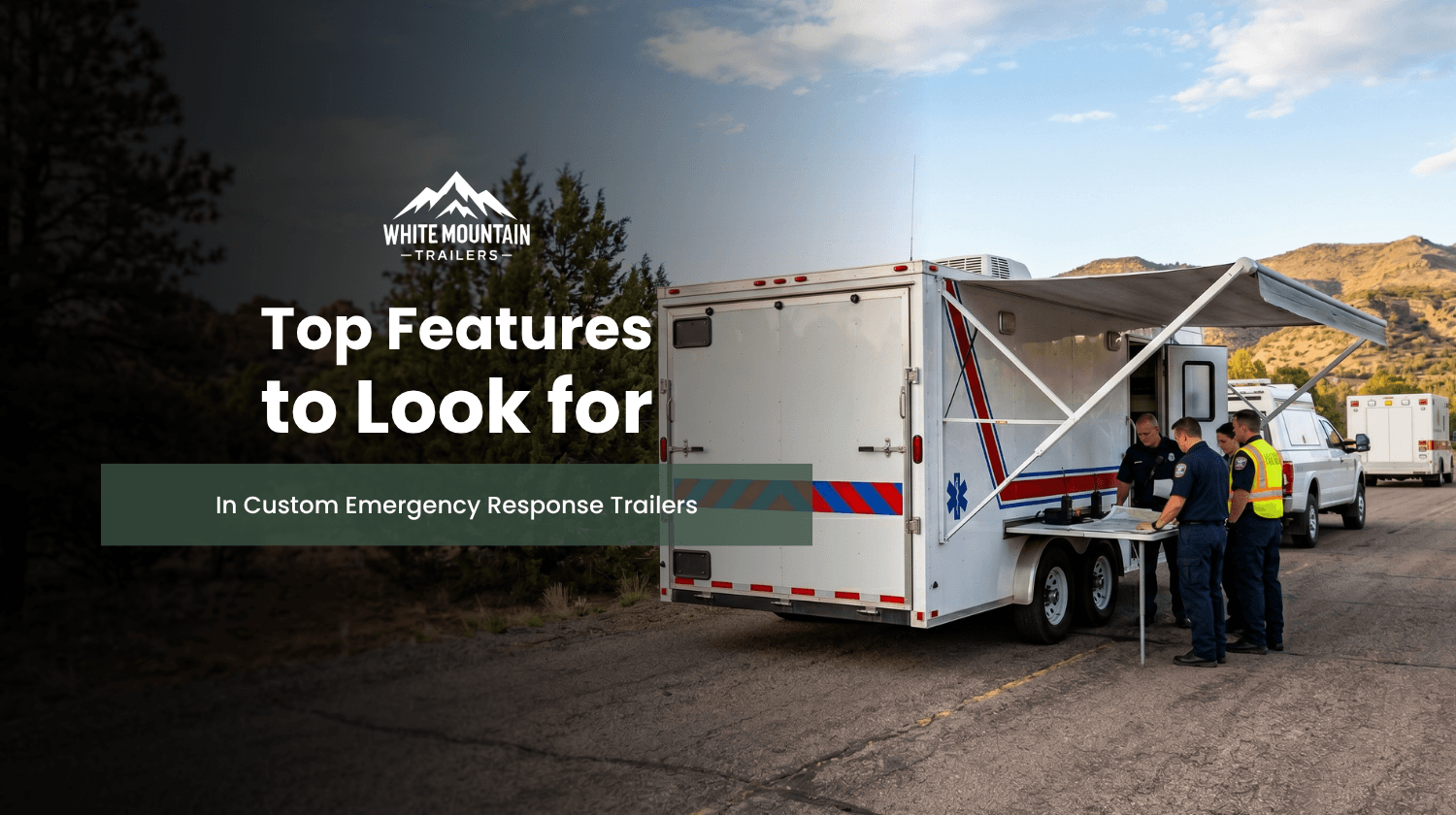
Top Features to Look for in Custom Emergency Response Trailers
When a crisis hits—whether it is a severe natural disaster, a large-scale hazardous materials (HazMat) incident, or a multi-agency law enforcement operation—the success of the deployment depends entirely on self-sufficiency. Standard cargo setups fall short when communication infrastructure drops and the local power grid goes black.
Building a high-performance custom emergency response trailer or a specialized mobile command trailer requires analyzing specific foundational features. Responders need an asset that operates completely off-grid, deploys in minutes, and supports real-time multi-agency coordination under extreme stress.
At White Mountain Trailers, we specialize in manufacturing rugged, commercial-grade disaster response trailers right here in Show Low, Arizona. Designed to handle the punishing demands of the Northern Arizona high country and regional wildfire response corridors, our units provide public safety agencies with an uncompromised, mobile operational base.
1. Off-Grid Power Resilience and Redundancy
A mobile emergency response unit is only as useful as its ability to stay powered without a local utility grid. Custom trailers must utilize a multi-layered, redundant power architecture to ensure critical equipment stays online indefinitely.
[Shore Power / Grid Connection] ──┐
├──> [Automatic Transfer Switch] ──> [Critical Mission Systems]
[Onboard Diesel Generator] ──┤ (Radios, Satellites, HVAC)
│
[Solar Array + AGM Battery Bank] ──┘
- Commercial-Grade Onboard Generators: High-capacity diesel generators (such as 7,000 to 10,000-watt units) tied directly to high-volume fuel tanks (60+ gallons) ensure operations can run uninterrupted for days. Look for models featuring automatic transfer switches that seamlessly swap power sources if the main feed fails.
- Solar and Battery Integration: Roof-mounted solar arrays paired with heavy-duty Absorbent Glass Mat (AGM) deep-cycle batteries or lithium iron phosphate ($LiFePO_4$) banks provide continuous silent power. This setup runs critical 12V LED lighting, charging ports, and electronics without constantly burning fuel or generating noise.
- Auto-Eject Shore Power Connections: For vehicles parked in a fire bay or staged near temporary grid power, a specialized auto-eject plug immediately disconnects the shoreline the moment the towing vehicle starts, preventing accidental cord damage during a rapid deployment.
2. Advanced Communication and Data Routing Infrastructure
During large-scale incidents, local cellular towers are frequently overwhelmed or entirely non-functional. An effective emergency communication trailer acts as a self-contained local network hub, bridging information gaps across field teams.
- Pneumatic Mast Systems and Satellite Uplinks: Custom units feature roof-integrated satellite dishes (like Starlink Business or military-grade VSAT) paired with telescoping pneumatic masts. These masts lift high-gain radio antennas, cellular amplifiers, and 360-degree PTZ surveillance cameras well above mountain terrain obstructions.
- Unified Radio Interoperability Interfaces: True incident command trailers integrate specialized cross-band routers. These systems cross-patch disparate radio frequencies in real-time, allowing police, fire, EMS, and state agencies to communicate directly across their existing hardware.
- Ruggedized Local Data Routing: Internally, trailers should feature complete Cat6 or fiber-optic network distributions, waterproof exterior data ports, and high-density interior workstations equipped with dedicated AC/USB power configurations.
3. Structural Integrity and Rapid-Deployment Layouts
When responding to remote areas or navigating debris-strewn disaster zones, the structural chassis of an emergency support trailer must withstand immense physical punishment while remaining easy to set up.
Structural Feature | Standard Commercial Trailers | Custom Emergency Operations Trailers |
Chassis Framework | Lightweight stamped steel or thin perimeter frames. | Heavy-Duty Tube Construction: All-tube aluminum or high-strength steel frames with reinforced crossmembers spaced 16″ on-center. |
Suspension & Axles | Traditional leaf-spring axles prone to jarring internal electronics. | Torsion Axles with Electric Brakes: Smooth, independent rubber torsion systems that absorb road shock to protect delicate server racks. |
Space Maximization | Fixed rectangular walls limiting interior movement. | Hydraulic Slideouts & Expanding Wings: Push-button automated slideouts that widen the footprint up to 90+ square meters on scene. |
To reduce setup times to under 15 minutes, rapid-response trailers utilize automated stabilization jacks, continuous-hinge heavy-duty rear ramp doors with non-slip finishes, and drop-down side awnings to establish an immediate dry outdoor triage or briefing space.
4. Specialized Interior Layouts and Environmental Control
The internal environment of an emergency operations center trailer must keep responders focused by eliminating distractions caused by extreme weather, fatigue, or poor organization.
- Multi-Zone Commercial HVAC Systems: Operations often span intense temperature ranges, from deep winter freezes in Flagstaff to blistering summer heat in the lower desert valleys. Low-profile, high-output air conditioning systems equipped with integrated heating strips keep internal electronics at baseline operating temperatures while removing moisture.
- Modular Cache Storage and Secure Tracking: Tool walls, heavy-duty cargo strapping networks, surface-mounted E-track systems, and specialized steel shelving units keep rescue gear, self-contained breathing apparatuses (SCBA), and medical supplies locked firmly in place during transit.
- Sterile, High-Utility Workspaces: Interior surfaces should feature screwless, non-porous antimicrobial aluminum walls and ceilings that resist chemical absorption and permit easy wipe-downs. Magnetic whiteboard walls allow command staff to map tracking logs and operational objectives dynamically on scene.
Trust White Mountain Trailers for Your Next Public Safety Build
Leaving your team’s command infrastructure to basic cargo conversions introduces unnecessary risks when lives are on the line. At White Mountain Trailers, we build customized emergency services trailers from the ground up, ensuring every weld, power line, and data port meets exact public safety specifications.
Ready to consult with an expert on your agency’s unique operational needs? Give our facility a call at 928-358-8404, visit our manufacturing center in Show Low, Arizona, or contact us directly at wmtrailers.com to request a custom blueprint quote today.